
• About me (Gary L. Herstein, Ph.D.) / Contact form
  • Furious Vexation (general questions here)
  • Statement of Intent
  • With regard to Comments and Spam

THE QUANTUM of EXPLANATION

~ Science, logic, and ethics, from a Whiteheadian Pragmatist perspective (go figure)

THE QUANTUM of EXPLANATION

Category Archives: Process Philosophy

Strains, Planes, and Flat Loci

22 Saturday May 2021

Posted by Gary Herstein in Emergence, Logic, measurement, Mereology, Metaphysics, Process Philosophy

≈ 1 Comment

Tags

Logic, Process Philosophy

A running joke that Dr. Auxier and I incorporated into our booki was the phrase, “skip to page 337.” The pagination reference is to the Free Press edition of the corrected version of Whitehead’s monumental work of metaphysics, Process and Reality (“PR” hereafter.) Page 337 of PR is the start of the fifth part of the work, his rather poetic discussion on “God,” beyond the more concrete arguments of the preceding 337 pages. By “concrete” it should be understood that Whitehead’s “God” is not some religion inspiring big daddy in the sky that you go to church to beg candy from. Uneducated rumors to the contrary not withstanding, Whitehead never invented words. But at many points in his tome on “speculative philosophy” (his preferred term for what others call “metaphysics”) he needed to identify an “omega point” which served as the entirely impersonal foundation for the rational structure of the world as well as the “font of creativity.” He called this “God.” Were he inclined to use non-English words, a better choice might have been the Greek “arché” (αρχη). But Whitehead was Whitehead, and that was never going to happen, and so it did not.

Setting aside for the moment the question of “God,” there are some important issues in the material that the people skipping over to pg. 337 are, in fact, skipping over, in their stampeding rush to gin up a “Whiteheadian” theology. There are two things I want to talk about that are left all but untouched in the secondary literature on Whitehead, one of which is interesting and the other is downright revolutionary. These things appear in the pages that many scholars ignore when the skip to pg. 337. They are what Whitehead called “strains” and “flat loci.” I’ll address these in order. But first I’ll devote a paragraph to the work on natural philosophy that Whitehead developed in the years preceding PR.
Pages: 1 2

Book Sale

13 Wednesday May 2020

Posted by Gary Herstein in Process Philosophy, Whitehead

≈ 2 Comments

Tags

Process Philosophy, Whitehead

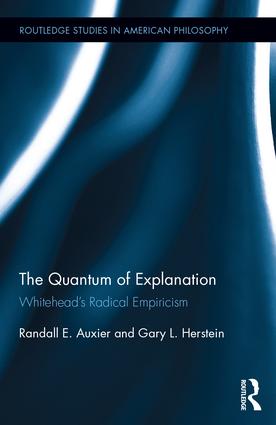
Taylor/Francis (Routledge) is having a sale on electronic versions of the book I coauthored (and which this blog is named after) The Quantum of Explanation: Whitehead’s Radical Empiricism. The note from Routledge reads as follows:

(W)e’re running a monograph sale through June 11th. Readers can now access your book free-of-charge for seven days. At the end of the trial period, they’ll have the opportunity to purchase the eBook for £10/$15.

https://tfstore.kortext.com/the-quantum-of-explanation-215103 (EPUB version)

https://tfstore.kortext.com/the-quantum-of-explanation-199954 (PDF version)

While I am obviously biased, many people who are not me also think that it is a very good book — indeed, one of the most important contributions to Whitehead scholarship in the last few decades. Many books in the secondary literature get Whitehead wrong; if you read our book, you’ll have some idea just how wrong. But in addition, Quantum will (ideally) provide you with essential insights into Whitehead’s magnum opus, Process and Reality, so that you might see for yourself why this latter book is such a revolution in thinking for the Western tradition. I’m not making any money off of this sale, and the price being asked by Routledge is pretty nearly unbeatable. So I encourage you to check it out!

quantum-of-explanation

Nonsense on Stilts

06 Wednesday Nov 2019

Posted by Gary Herstein in Logic, Metaphysics, Process Philosophy, Relationalism

≈ Leave a comment

Tags

Possibility, Process Philosophy, Relational thinking

The Washington Post had an article in their science section a few days ago announcing “Scientists are baffled: What’s up with the universe?” It is a welcome relief to see mainstream reporting paying some attention to the massive problems that absolutely dog contemporary gravitational cosmology. One more frequently encounters a breathless declaration that this or that latest “discovery” “confirms” the Standard Model of Gravitational Cosmology (“SMGC”),i yet which then goes on to announce that we’ll need a “whole new physics” to make sense of this new data. (This article from The Guardian is slightly more balanced than many of the sources that later picked up the same story.) But the deeply problematic nature of SMGC is not really news, nor are the issues mentioned in the WaPo article even the most directly pressing matters. An extensive review of many of these problems may be found in the newsletters of the A(lternative) Cosmology Group. While a serious measure of background in mathematics and physics is required to read the listed and cited papers at any level of comprehension, a person with a basic background in these topics will be able to follow the newsletter discussions themselves and gain a modest acquaintance with the issues.Stilts

There are yet other issues that appear where SMGC intersects with micro-physics, in the realm of quantum mechanics. Part of the problem is that the mathematical bases of these two realms of inquiry – which, in the case of SMGC, is Einstein’s general theory of relativity (“GR”) – are built around radically different and largely incompatible kinds of mathematical structures: quantum mechanics, for all of its peculiarities, is linear in nature, while GR is fundamentally non-linear. This unification of the macro and the micro levels continues to defy serious scientific efforts, but the emphasis here is most definitely on “serious.” Unserious – because blatantly unscientific – efforts have given us the “string theory” nonsense which, while mathematically clever (at least by some accounts) is empirically vacuous, and as such devoid of any actual scientific content. Indeed, string-theory is so lacking in any basic scientific standing that not only is it empty of any actual empirical content, it lacks even the possibility of such content. Philosophers being disdained by the gate-keepers of SMGC – persons such as Brian Greene, Stephen Hawking, Neil DeGrasse Tyson, and Sean Carroll – one may also turn to the observations of scientists such as Lee Smolin and Peter Woit for confirmation of these statements. Continue reading →

Pressure. Cooker.

22 Monday Apr 2019

Posted by Gary Herstein in Personal History, Process Philosophy, Relationalism

≈ Leave a comment

Tags

Process Philosophy, Psychology, Relational thinking

My limited, and very humble, cooking experiences have never involved a pressure cooker. However, I do understand a little about how they function and why they are used. For many dishes, it suffices to permit the steam generated by cooking to pass out of the cooking vessel, and permit the food to otherwise be finished by ordinary methods of heating. But some recipes require that the food be cooked in a more intense manner: the steam that might otherwise be released unused into the indifferent world are instead contained under pressure, and that pressure in turn forces that steam back into the food, to provide an especially deep, internal, and unremitting form of cooking. This is all just physics, lacking the resources and the motivation to attempt such recipes, I’ve no idea what the process or products actually look like. My motivation for mentioning it is quite different from culinary compositions.Pressure Cooker

Cooking is often used as a basis for metaphors for human psychology. For example, a person who is “fried” or “baked” is someone who is exploring better living through chemistry. “Scrambled” is great for eggs, but speaks to a chaotic and disorganized state of mind in a person. Steamed vegetables have a happy crunch, but a person who is steamed is likely to be poor company. So the effect on the person is often taken from the effect on the food, rather than our enjoyment of that effect. (Presumably, the vegetable derives no joy from being steamed.) But the usefulness of such metaphors is always limited, and sometimes just genuinely wrong. Such can be the case with pressure cooker images. Continue reading →

Now

12 Wednesday Dec 2018

Posted by Gary Herstein in General Philosophy, Metaphysics, Process Philosophy

≈ 9 Comments

Tags

Metaphysics, Process Philosophy, Time

This is the follow up to my previous post. We are vexed, perplexed, by time. Augustine famously quipped regarding time something along the lines that, “As long as no one asks me, I know exactly what it is. As soon as someone asks me, I have no idea.” Myself, I remain struck by the rhetoric and poetry of a line from the first Star Trek: The Next Generation movie: “Time is the fire in which we all burn,” a sentiment which the film, in the person of Patrick Stewart’s “Jean Luc Picard,” ultimately rejects. Myself, I find both of these approaches unsatisfying, because they both treat time as a “thing” that “is.” Language seems to force this on us. But time is not an “object” lying there on the rug like something the cat dragged in; time is the cat that dragged that thing in in the first place, as well as the rug where it was deposited.Exif_JPEG_422

Backing off a bit from my (once again) colorful, and probably not very helpful, language, time is not a “thing” sitting there awaiting our observation and description; time is the context in which all objects present themselves to be possibly observed, described, or otherwise interacted with. Additionally, time is not a string of “point-like” (I often use the term “punctiform,” but this evidently has a medical usage that is NOT what I intend) infinitesimal moments on a string, like numbers on the real line. This latter is how modern physics deals with the subject of time, but this approach substitutes an abstract mathematization for the actual facts of experience, justified exclusively on the grounds that it makes our mathematics simpler. But reality does not pretzel itself to fit the simplicity of our theories, a fact which many people dazzled by mathematics seem to have lost sight of. Our only access to that reality is via our experience, and so our theories must bow to that experience and not the other way around. And time never comes in inexperienceable, infinitesimal points; it is the context through which nature flows, and always presents those contexts in stretches or “durations.” For my purposes, I am taking this fact as given; for a detailed argument about this “point” see chapter 3 of Whitehead’s The Concept of Nature. Continue reading →

Meaningful Life

11 Tuesday Dec 2018

Posted by Gary Herstein in General Philosophy, Metaphysics, Process Philosophy, Relationalism

≈ 1 Comment

Tags

General Philosophy, Metaphysics, Relational thinking

It is easy to find meaning in life in general; any herd of halfwits with a few books of philosophy under their respective or collective belts can do as much. But is MY life in particular meaningful? That is a very different question. The short answer – which, as always, will require a lengthy explanation – is, “maybe not.” But that “maybe not” itself comes with an important qualifier: almost certainly not in the form you were expecting. Right there is the primer that starts the engine of existentialism sputtering in poorly tuned outrage; that, and my grossly mixed metaphors. Not to take too much credit, but the latter might be the more important factor …Dusk

Nevertheless, there are two terms in the foregoing that merit some initial attention because of the oft unattended distinctions they bring into play: the “general” and the “particular”. In the spectrum of reasons, these two modalities of qualification are fairly far apart. Yet a great deal of discussion around the vitally important topic of the meaning of life flounders precisely on problem of navigating between these two rocks – this Scylla and Charybdis, to abuse my metaphors even further – that aren’t even all that close together. Navigating between them ought to be as straight forward as understanding if one is in the Atlantic or the Pacific oceans. Yet I don’t recall ever seeing matters satisfactorily distinguished, which is (like as not) as much a sad commentary on my scholarship as anything. So prior to getting to matters of any real substance, I must spend a few words on the interface between logic and metaphysics, so as to highlight the overlap between metaphysics and facts. Continue reading →

Objects and Relations

19 Monday Nov 2018

Posted by Gary Herstein in Logic, Process Philosophy, Relationalism

≈ Leave a comment

Tags

Logic, Process Philosophy, Relational thinking

Let’s get (a little) mathematical. If you’re still reading, good for you!

I spend a fair amount of time reading various logic texts. Most of that time, these days, is spent on texts that are shared with a “Creative Commons” license, and are thus freely downloadable. This is for two reasons: first, I am deeply offended by contemporary text book prices. For example, Hurley’s logic book (you can look that up on your own) is around $100.00 for the more recent editions. Not as bad as Calculus text books, but certainly extreme when one considers that the material presented can be had for free from other sources. So, despite the overwhelming improbability of it ever occurring, I can’t stop myself from thinking about the scam inherent in textbook pricing, and thinking how I, as a would-be teacher, might better serve my students w/o bankrupting them.Venn diagram

The second reason is that I just really like the subject, and want to keep my nose in the books on this subject at all times. Like playing the cello, if you stop practicing, you lose whatever mastery you may once have possessed. (The cello analogy is in reference to the great Pablo Casals and the possibly apocryphal response(s) he gave to why he always practiced so diligently.) Since I am otherwise utterly penurious, my choice of texts to “practice” with are limited to what I can download for free. With respect to topics within mathematics, including formal logic, the range of materials is actually enormous, and the quality exceptionally good. One of these books is the Open Logic Text by the Open Logic Group (“OL”), licensed under Creative Commons international attribution 4.0. (I believe I have fulfilled my legal obligations in the forgoing; full .PDF HERE.) I very much approve of this text, and almost anyone but me would never have even the slightest critique to offer regarding its exceptionally comprehensive coverage of the topic in a readily understandable fashion. But I do have one criticism, one that pretty much no one but a Whiteheadian would ever think to make. And that is about their too sanguine opening about the centrality of sets, and their uncritical acceptance of an intransigently object structured thinking. Continue reading →

At Least I Have Chicken

17 Wednesday Oct 2018

Posted by Gary Herstein in Critical Thinking, General Philosophy, John Dewey, Process Philosophy

≈ 2 Comments

Tags

Community, Humor, Philosophy

Person’s familiar with the gaming world might well recognize the title of this essay as a quote from a famous incident in the online game World of Warcraft. The incident, recorded and posted on YouTube (see video below) might be labeled The Last Charge of Leroy Jenkins. A group of players are nervously planning a complex attack against a difficult, game generated collection of very dangerous “creatures” (the online game permits players in remote locations to play together, and communicate verbally even as they operate their “character” in the game.) But after a few minutes of this, one of them (“Leroy Jenkins”) loses all patience with the process, declares “Enough talk!” and rushes into the midst of the creatures bellowing his battle cry, “LEEEROY JENKINS!!!” Caught off guard, the other members of the team realize they’ve lost the advantage of surprise and follow in, only to have the entire team wiped out by this cluster of creatures. As they bitterly review this catastrophe, casting an occasional word of criticism in Jenkins’ direction, Leroy simply responds, “At least I have chicken” (presumably in his real world crib, as there is none in the game.)

The whole thing is much funnier if you’ve had any experience with multi-player roll-playing games, whether online, networked, or old school paper and painted tokens D&D. But the behavior is familiar to us all from the broader reaches of our lives, as we recognize a form of doomed compromise that those around us – and most likely we ourselves, at one time or another – have made. This came out again recently in a colleagues interaction with the students in his class. (It is not revealing much to note that said colleague is, indeed, a man.) The colleague was presenting one of the classic figures of Western philosophy, and the students began asking in reply, “but how important is this really?” Discussion went back and forth a few times until finally exasperated, my colleague said something to the effect that, “the alternative is to be an uneducated pawn in a machine that views you as nothing more than a commodity to be used until you’re used up, suffering the waste of your life in a job that offers no fulfillment, living in a house in the suburbs with a spouse that is indifferent to you and children that despise you!” There was a moment’s silence, when finally one student replied, “at least we’ll have a house in the suburbs.”

At least they’ll have chicken. Continue reading →

Self-Identity

27 Tuesday Feb 2018

Posted by Gary Herstein in Logic, Mathematics, Metaphysics, Ontology, Process Philosophy, Relationalism

≈ 2 Comments

Tags

Logic, mathematics, Metaphysics, Process Philosophy

I was not an especially “outward looking” or alert youth, working rather to shut the world out rather than invest painful consideration into something that was already almost unbearably painful. But occasionally my habits of thinking would turn themselves outward, to chew on a puzzle that had managed to break through my protective shell and demand my attention. This happened twice that I can recall in high school: the first time, after an especially depressing episode I realized I needed to make a study of reading people – perhaps, more importantly, I realized that I could learn this, and I began picking up clues effectively and rapidly. The second, and first genuinely philosophical moment, was when I “discovered” the “problem of evil” as it related to the born-again Christianity I’d been emotionally bullied into accepting by various members of my family – personal responsibility is a joke, of course, in any world dominated by an omniscient and omnipotent creator god. This began my “angry atheist” phase, which went on for another decade (until I’d actually read a substantial bit of philosophy.)Acropolis1

The third “break through” (second genuinely philosophical one) happened when I was in the army. I was stationed some 18 kliks from what was (at the time) the East German border, in the Central German highlands, as an electronics tech in an Improved HAWK anti-aircraft missile battery. Every year, each such unit chose a squad of people to be sent to NAMFI, Crete, to spend a few days training, culminating in firing a live bird at a drone target. As it happened (then, at least), the entire trip involved several days both before and after the actual training which were free time for the troops to explore the island or, as several of us chose to do, take the ferry from Souda bay to the Piraeus and Athens. So it came to pass that I climbed the steps up the hill of the Acropolis. Except, that’s not quite right. Nobody actually walked on those steps, and it wasn’t out of respect for their antiquity. Continue reading →

Making Sense

12 Monday Feb 2018

Posted by Gary Herstein in General Philosophy, Inquiry, Logic, Metaphysics, Philosophy of Science, Process Philosophy, Whitehead

≈ Leave a comment

Tags

Logic, Metaphysics, Process Philosophy, Whitehead

Whitehead set out to make sense of things. After witnessing all of his attempts to point out how Einstein’s general theory of relativity failed to make the sense it claimed to make (and still fails to do so, but the model centrists won’t permit empirical evidence to get in the way of their clever mathematics), he arguably decided that he needed to step back from epistemology and philosophy of science, to present a more logically primary argument, in the metaphysical form of his “philosophy of organism.” Whitehead centered his argument on what I and Randy Auxier named “the quantum of explanation,” a logical (rather than ontological) center, around which Whitehead constructed his subtle and complex system of making sense. It has been suggested that Whitehead’s magnum opus, Process and Reality, is one of the five most difficulty works in the Western philosophical canon. I’m not inclined to argue with such a sentiment, since the most that could be credibly argued is that it might be knocked back to sixth place. For my part, I’m not sure what work could manage that feat.No Sense

One of the points that Randy and I tried to emphasize was that the process of “making sense” was itself a rather complex process, in which the most active word in the proceeding is process: this is not an object you hold, but an activity you engage in. So despite my habitual focus upon contemporary science &/or concerns, this is actually as classic an issue as you can find in the Western philosophical canon. (And I just don’t have the expertise to speak with even casual ignorance about the Eastern canon, a source of inestimable insight and subtlety. I am, however, inclined – ignorant as I am – to suspect that what I have to say here can find its analogs in that tradition.) Continue reading →

← Older posts
Newer posts →
Follow THE QUANTUM of EXPLANATION on WordPress.com

Enter your email address to follow this blog and receive notifications of new posts by email.

Blogs I Follow

  • Homotopy Type Theory
  • The Shanarchist Cookbook
  • Cote du Golfe School of Fencing
  • Professor Watchlist redux
  • Free Range Philosophers
  • thenonsequitur.com
Whitehead, Alfred North

Copyright Announcement

© Dr. Gary L. Herstein and garyherstein.com, 2014 -- 2024. Unauthorized use and/or duplication of this material without express and written permission from this site’s author and/or owner is strictly prohibited. Excerpts and links may be used, provided that full and clear credit is given to Dr. Gary L. Herstein and garyherstein.com with appropriate and specific direction to the original content. (In other words, share but acknowledge.)

← Back

Thank you for your response. ✨

“But in the real world it is more important that a proposition be interesting than that it be true. The importance of truth is, that it adds to interest.” – Alfred North Whitehead, Process and Reality

Archives

Spam Blocked

70,611 spam blocked by Akismet

Blog at WordPress.com.

Homotopy Type Theory

The Shanarchist Cookbook

Cooking up food for thought & Shanarchy. I am a Philosopher, writer, meditation & mindfulness teacher, & artist.

Cote du Golfe School of Fencing

Fencing / Sword Classes & Lessons Naples, Bonita, Estero, Florida

Professor Watchlist redux

Free Range Philosophers

Loving Wisdom Beyond the Academy

thenonsequitur.com

  • Subscribe Subscribed
    • THE QUANTUM of EXPLANATION
    • Join 123 other subscribers
    • Already have a WordPress.com account? Log in now.
    • THE QUANTUM of EXPLANATION
    • Subscribe Subscribed
    • Sign up
    • Log in
    • Report this content
    • View site in Reader
    • Manage subscriptions
    • Collapse this bar
 

Loading Comments...