There is a philosophical position known as “panpsychism.” While it is not an overwhelmingly popular position, it has been getting some attention of late. And as Whitehead himself is frequently characterized as a panpsychist, it seems worthwhile to cast an eye on this notion and say something about it. And of course, the first thing one should say should be an answer to Gollum’s question (“What is it, Precious?”)
The basic idea of panpsychism is that mental activity (the “psych” in “psychism”) is everywhere (the “pan” part. And by everywhere, it is meant to be at all levels of reality, large or small. Mental activity is, in this view, a fundamental element of all that is real, an ontological “primitive” (if you will) that is not constructed from other elements but rather is itself something that is always already “there.” The advantage of this notion is that it goes a long way to resolving the “mind/body” problem by basically arguing that there was never a real problem, only a problematic and erroneous characterization of the real.
Get your mind out of the gutter, it was nothing like that. I did a presentation at the Personalist Forum conference, which happened to take place fairly close to where I live. (Normally it is at Western Carolina University, but due to scheduling conflicts had to be moved.) This year’s venue was at the American Institute of Philosophical and Cultural Thought, here in Southern Illinois. The topic is about learning the basic tools needed to genuinely follow Whitehead’s thought. The title is Learning the “Language,” where ‘language’ is very deliberately scare quoted.
This talk came hard on the heels (as opposed to “heals,” though that too is relevant in an ironic way) of a major surgery I’d just been through. While complicated enough under the best of circumstances, my procedure proved to be especially difficult. By all estimates, I came through it with flying colors, but I was still quite punchy at the time I made my presentation. I mention this in the talk.
I do word stuff with my mouth.
That being said, it came off quite well. The subject is “close to my heart,” as it were, and even working from nothing more than an outline I was able to present my case. As I say in the talk, my hope is and remains that the failings of the presentation and the presenter do not mask the fact that there is a legitimate issue and complaint involved in much of existing Whitehead scholarship. Below is the suggested reading list I handed out at the talk, which I’ve expanded a little for this blog post.
As a rule, I despise pictures of myself, and find videos simply unwatchable. I did finally watch this one, and it is less execrable than one might otherwise suppose.
Suggested Readings
Habit of thought:
Alfred North Whitehead, Principles of Mathematics (New York: Henry Holt, 1911.) Free for the download from Project Gutenberg, https://www.gutenberg.org/ebooks/41568
Philip J. Davis and Reuben Hersh, The Mathematical Experience (New York: Harper Paperbacks, 1999.) This book really cannot be praised enough, a book that everyone should read regardless of their interest in Whitehead.
Morris Kline, Mathematics for the Nonmathematician (Mineola: Dover Books, 1985.)
George Polya, Mathematics and Plausible Reasoning, vol. 1 & 2 (Princeton: Princeton University Press, 1990.)
Thomas Tymoczko (Editor), New Directions in the Philosophy of Mathematics (Princeton: Princeton University Press, 1998.) Part of the effort to understand mathematics as inquiry, rather than set theory done badly.
Hermann Weyl, Symmetry (Princeton: Princeton University Press, 1981.) One of those books that earns the label “classic,” this introduces some of the essential characteristics of group theory without getting into a lot of mathematics.
History:
Edna Kramer, Nature and Growth of Modern Mathematics (Princeton: Princeton University Press, 1981.) For my money, hands down the best general history out there. So of course it is out of print, impossible to find, and insanely expensive.
Morris Kline, Mathematical Thought From Ancient to Modern Times, volumes 1 – 3 (Oxford: Oxford University Press, 1990.) Pretty good, and at least it can be had without mortgaging your first born child.
Leo Corry, Modern Algebra and the Rise of Mathematical Structures (Basel: Birkhäuser, 2003.) This is an outstanding book, delving into the origins and problems that led to the emergence of abstract algebra, from the 1820’s to the 1940’s. Whitehead is discussed, but not very closely. Still, the nature of abstract algebra is developed in its historical context to a degree not available anywhere else. By my standards, the book is on the pricey side, but still well worth the investment
Abstract Algebra:
There are plenty of good books out there. The trouble is that it is quite difficult to get your head wrapped around the topic w/o some kind of mentor (i.e., math professor) there to help you out. Keep in mind that math books are the hardest to copy edit, because the editor must be as good at math as the author (which never happens.) So you’ll find yourself up against a wall where you’re wondering if you simply don’t understand what’s being said, or if there’s a typographical error in the text. I solved the problem by getting an MA at DePaul.
But if you want to give it a go on your own, most any intro book from Dover will do:
Nathan Jacobson, Basic Algebra, vol. I & II (Mineola: Dover Publishing, 2009.) These two volumes are exceptional for their comprehensiveness. I originally acquired these books as first edition hard covers, back when a hard cover cost a little less than a new car. I liked them well enough that when I discovered that Dover had them as eBooks I purchased them again so that I’d have a copy on my kindle. Be warned, though: the “basic” in the title is a tad misleading. These are the books that convinced me I needed to return to graduate school to learn abstract algebra.
There is a certain group of scholars – I’ll name no names – which has taken on such a dominant position in Whitehead scholarship (at least, within the US), that one could arguably characterize their position as “hegemonic.” I have personally met a number of individuals associated with this group, whom I’ll simply call “The Group,” and freely admit that they are, as individuals, fine, generous, and altogether excellent folks. My complaint here – and I will be complaining rather sharply – is not with any of them as particular persons, but rather with the hegemonic direction in which The Group has taken Whitehead scholarship. That direction is what I am calling “Happy-Fluffy-Touchy-Feely-God-Talk” (HFTFGT from now on.)
Now, there is no question that Whitehead spoke of “God” extensively in his writings. Many people have the devil’s own time with such talk, those whom I’ll often characterize as “Ouchie Atheists,” for whom any such discussion drives them either into a fury or else into something like a cognitive anaphylactic shock. (Sometimes both.) This is one of the lesser pities of our day and age, a consequence of neo-fascist Christian Dominionist fundamentalists having hijacked the word and all discussions thereof. It is additionally unfortunate with regard to Whitehead scholarship because his use of the “G-word” could easily be replaced throughout his text with the Greek word “arché,” which would eliminate at a stroke the difficulties the Ouchie Atheists have and (arguably, at least) make it possible for them to dive more deeply into Whitehead’s texts and arguments. But Whitehead was intransigent in his refusal to employ non-English words. “Atom” was an exception. Though it originated with the Greeks, it had by his time – both by convention and courtesy – been thoroughly adopted as “English.” This is a little ironic, since contrary to most physicists of his day, Whitehead continued to use it in the original Greek sense of “a-tomos,” meaning “uncut.” So an atom for Whitehead was not a microscopic corpuscle, but an undivided whole which could be of any size.
I like the word “arché” because it can be translated as “foundation/font,” and this is what Whitehead meant by “God”: the rational foundation of reality, and the font of creativity. (This latter is one of the things that distinguishes process philosophies from static, substance based ones: the universe is a process of creative advance.) Notice that I do not suggest the Greek word for “god,” “theos” (or possibly “theou,” my Greek is not very good.) This is a deliberate choice, readily justifiable by even a moderately close reading of what Whitehead actually says, particularly within the pages of his masterwork of metaphysics, Process and Reality (PR).
With, however, the exception of one sentence.
This sentence appears in the last few pages of PR, which are separated from the rest of the volume as Part V. The language and argument of this final, very short “part” is fundamentally different from the preceding hundreds-plus pages of text, and this radical difference has led some to wonder just how genuinely integral an element of the rest of the discussion it truly is. In these final, very few pages, Whitehead allows himself to slip into more poetic language, most particularly with the above mentioned one sentence – which I’ll not quote. (If you know, you know, and if you don’t you’ll recognize it instantly should you ever read PR to the end.) But members of The Group, and others sympathetic to their program, latched onto that one sentence and ran with it. They ran fast, long, and hard, and are still running. From this we get the HFTFGT of process theology.
And it has swallowed the scholarship whole. So much so that Whitehead’s triptych of 1919 – 1922 (Enquiry into The Principles of Natural Knowledge, The Concept of Nature, and The Principle of Relativity with Applications), a revolutionary re-evaluation of the entire philosophy of nature, have largely vanished from the canon of Whitehead’s works that are studied. (Let me reiterate that this is within the US. Chinese scholars, for example, recently celebrated the centennial of those works with no fewer than three separate conferences, one for each book.)
Even those works of Whitehead’s that do receive some attention receive it only selectively. Thus part IV of PR, for example, is often skipped over and ignored with students sometimes being told to ignore it because it is “irrelevant.” One might, alternatively, point out that part IV is the beating heart of Whitehead’s entire relational system, where he presents his mature mereotopology, his non-metrical theory of curvature (“flat loci”), his subtle theory of physical connectedness and causality (“strains”), his completed theory on the internalization of relatedness as the flipside to the theory of the externalization of relatedness found in part III, etc. But part IV also involves a lot of logical and mathematical thinking “stuff,” and so one can just skip over that because it doesn’t feed into HFTFGT. A more cautious reader might suspect that what this rather demonstrates is that it is HFTFGT that is flopping around looking for relevance. But such cautious readers are not being invited into the club, and their professors are not encouraging their students to adopt such cautious approaches.
It is partly as a result of this narrow and eminently disputable presentation of Whitehead’s philosophy that many outside the field who might otherwise profit from engaging with Whitehead’s ideas (especially persons in the sciences), explicitly reject the notion out of hand. Because, after all, Whitehead is “nothing more than” a lot of HFTFGT. And people “just know this to be the case” because they are constantly and loudly reminded of this “fact” by those experts who are only interested in HFTFGT.
(Of course, persons in the physical sciences tend to reject any suggestion of engaging in philosophy because it is, after all, philosophy. They often do this as they explicitly engage in philosophical discourse; and do so badly.)
Such a reductionist caricature of Whitehead’s thought is, of course, the worst sort grotesquely fatuous twaddle imaginable. Let me repeat, Whitehead wholly re-imagines Nature in a relationally robust and holistic framework that is original, insightful, and logically rigorous. But consider in comparison what your grasp of Christianity might be were it the case that all you ever heard about it came from the neo-fascist Christian Dominionist fundamentalists. Your idea of Christ would look more like Adolf Hitler. (By the bye, in contrast to the neo-fascists, the advocates of HFTFGT promote a vastly more Christ-inspired vision of God and the gospels that is genuinely loving and caring for ALL of creation.) And so it becomes increasingly difficult to even suggest to people who are not already heavily, even exclusively, invested in HFTFGT to cast even a casual eye on Whitehead’s work.
Which brings us to the matter of how a vine can kill a tree.
There is a method of killing a tree called “girdling.” A tree grows out as well as up. But if something is tightly bound around the outside of the trunk (it is “girdled”) the tree can no longer grow outwards. And it is these outer portions that carry the nutrients up the trunk to the rest of the tree. So the effect is like a garrote.
A vine is capable of girdling a tree. There is no malevolence involved, no ill or predatory intent; but the effect is the same. This is what ‘The Group’ is doing, I would argue, to the larger tree of Whitehead scholarship. (One of the ironies here is that they themselves are being girdled by the neo-fascist Christian Dominionist fundamentalists, who deny that liberal – never mind process – theology even qualifies as Christianity, or as anything other than the work of the Devil, even though this form of “devilry” is demonstrably truer to the Gospels. But just try to find someone who is not already an expert in the field who is even aware of the existence of process theology.)
I don’t want the HFTHGT people to go away, but I would like to see a serious effort on their part to acknowledge that their project emerges from a vanishingly small corner of Whitehead’s work. I don’t want to chop down the vine, but I would like the vine to stop strangling the tree. This would include exercising some genuine circumspection about what they attribute to Whitehead, as opposed to what they themselves rather freely speculate about, far beyond anything he – in his meticulous, mathematically rigorous and disciplined way – ever pretended to entertain.
A scientist is someone who engages in inquiry to discover new facts
An engineer is someone who engages in inquiry to discover new applications for known facts.
A technician is someone who engages in inquiry to maintain known applications.
We can add to this the mode of inquiry which characterizes philosophy
A philosopher is someone who engages in inquiry in order to discover new meanings, and fully understand old ones.
Philosophers aren’t alone in this latter form of inquiry, but as I am a philosopher that is what I am working from. (Arguably, the philosopher’s position is more generalized and abstract than, say, that of the novelist.) I highlight the above so that we may take a poke at that most maddening and obscure subject, the meanings of Whitehead’s terms, (mostly) in his philosophical works. Because you’ll never learn the thinker’s meanings if you do not first learn the thinker’s language. With Whitehead, this means two things. First, you must “get inside” the structure of the man’s thinking, a step the overwhelming majority of scholars have categorically refused to do. The second is that you must disabuse yourself of the notion that, just because Whitehead uses a term that you find familiar, Whitehead is therefore using that term in a way that is familiar to you. This latter is the part that really drives some people – most especially myself – absolutely bananas.i We’ll approach these in order.
Now, while the second issue can drive one over the edge, I will add that the first one is pretty frustrating as well. In point of fact, it really, really annoys me. I mean, it REALLY annoys me. Let me illustrate it with a non-Whiteheadian example.
I recently went through major surgery. It was laparoscopic surgery, and involved five fairly small incisions, so in that respect it was relatively low on the trauma scale. On the other hand, the robotic instruments that went in through those various incisions removed two feet of my large intestine, from the right lower up to the right transverse section. Now, the large intestine in its unmodified, factory original adult condition is about six feet long all told. Nevertheless, one can say with some fairness at this point that my colon is now a semi-colon. In any event, the surgery went quite well, I’ve been home for well over two weeks now, with no pain and very little soreness to report.
Nevertheless, there is an ever-present awareness that my body has been cut into. I would not describe it as “acute;” rather it is more like an amber-tinged, quietly lingering sense of shock. One of the aspects of this lingering sense is that it is neither sub- nor un- nor pre-conscious. (Some philosophers have argued that the first two, at least, don’t even exist, and that the appeal to them by various psychiatric and psychological doctors is an error. This is not a topic I will explore, however.) Rather, the experience is a fully conscious one. But it is a consciousness that is entirely felt; there are no words attached to it until after I focus my attention fully upon the experience and begin to verbalize it via secondary and tertiary processes with respect to the primary experience itself. I’m characterizing this consciousness as nonverbal rather than as preverbal, because the “pre” suggests an ordering with respect to other conscious modalities that I am inclined to reject. So after saying a few more words about my own experience here, I hope to leverage that data to illuminate various philosophical ideas, mostly from Whitehead (of course) but not exclusively. Along the way, I also offer the following as my own little testament against toxic masculinity and its attendant infantilism.
Some sixty-one years ago, the American philosopher Willard Van Orman Quine wrote a famous essay, “On Simple Theories of a Complex World.” Actually, referring to this as a “famous essay” is a tad redundant, since Quine is one of those people who only ever wrote famous essays. But setting that observation (bordering on sour grapes) aside, Quine goes on to observe the difficulty in saying just what does qualify as simplicity. He further observes the legitimate psychological and formal reasons while theory builders so ardently crave simple theories: the simpler the theory, the more readily it can be employed in our various cognitive activities. Of course, too simple a theory leaves us with no purchase on the world what-so-ever. “God willed it” is about as simple a theory as you can come up with, but it is also as singularly useless a theory as anyone could ever imagine; it provides absolutely no insight, a complete absence of predictive power, and only an illusion of emotional comfort for those readily distracted by vacuous hand waving.
A “Rube Goldberg” machine.
Quine was writing more than a decade before the emergence of computational complexity as a sub-field of abstract Computer Science, in which upper and lower bounds for kinds of complexity (and thus, conversely, forms of simplicity) was even formulated. But we do now have a variety of ways to address Quine’s concerns about how to characterize complexity and simplicity. I’ll say more about this in a moment. What I want to start with a more controversial proposition: Namely, Quine got it backwards. In a very real sense, it is the world that is fundamentally simple and our theories that are complex.
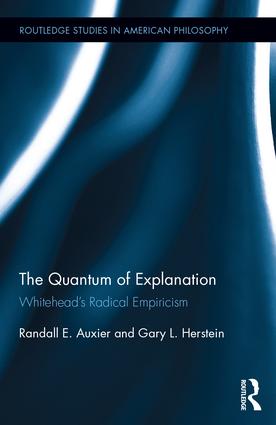
Taylor/Francis (Routledge) is having a sale on electronic versions of the book I coauthored (and which this blog is named after) The Quantum of Explanation: Whitehead’s Radical Empiricism. The note from Routledge reads as follows:
(W)e’re running a monograph sale through June 11th. Readers can now access your book free-of-charge for seven days. At the end of the trial period, they’ll have the opportunity to purchase the eBook for £10/$15.
While I am obviously biased, many people who are not me also think that it is a very good book — indeed, one of the most important contributions to Whitehead scholarship in the last few decades. Many books in the secondary literature get Whitehead wrong; if you read our book, you’ll have some idea just how wrong. But in addition, Quantum will (ideally) provide you with essential insights into Whitehead’s magnum opus, Process and Reality, so that you might see for yourself why this latter book is such a revolution in thinking for the Western tradition. I’m not making any money off of this sale, and the price being asked by Routledge is pretty nearly unbeatable. So I encourage you to check it out!
Whitehead set out to make sense of things. After witnessing all of his attempts to point out how Einstein’s general theory of relativity failed to make the sense it claimed to make (and still fails to do so, but the model centrists won’t permit empirical evidence to get in the way of their clever mathematics), he arguably decided that he needed to step back from epistemology and philosophy of science, to present a more logically primary argument, in the metaphysical form of his “philosophy of organism.” Whitehead centered his argument on what I and Randy Auxier named “the quantum of explanation,” a logical (rather than ontological) center, around which Whitehead constructed his subtle and complex system of making sense. It has been suggested that Whitehead’s magnum opus, Process and Reality, is one of the five most difficulty works in the Western philosophical canon. I’m not inclined to argue with such a sentiment, since the most that could be credibly argued is that it might be knocked back to sixth place. For my part, I’m not sure what work could manage that feat.
One of the points that Randy and I tried to emphasize was that the process of “making sense” was itself a rather complex process, in which the most active word in the proceeding is process: this is not an object you hold, but an activity you engage in. So despite my habitual focus upon contemporary science &/or concerns, this is actually as classic an issue as you can find in the Western philosophical canon. (And I just don’t have the expertise to speak with even casual ignorance about the Eastern canon, a source of inestimable insight and subtlety. I am, however, inclined – ignorant as I am – to suspect that what I have to say here can find its analogs in that tradition.) Continue reading →
“Personalism” is the philosophical position that the first principle in any approach to the world must be that of “person.” Given the habits we have inherited over the years from our scientific (scientistic?) approaches to reality, this might seem like a hopelessly subjective approach to things. But such an attitude is wrong on at least two accounts: first, personalism is NOT the same as “subjectivism” – not by a long shot! The second major flaw is that there is nothing at all “hopeless” about it; indeed, there is a case to be made for its logical necessity. This last point is open to dispute to a degree that the first is not, and I’ll be focusing on this point a bit. Toward the end of this post, and in fulfillment of my priority to keep things Whiteheadian on this blog, I’ll gloss a few areas where Whiteheadians and personalists disagree, and the major point where they overlap. (Spoiler: Whitehead was not a personalist.)
I’ve no idea what picture to use for this post, so here is a picture of my cat, “Bluesy,” who is neither subject nor object, but rather person.
A point of terminology: if, along the way, I have cause to use the term “objectivism,” it should be clearly understood that I am not in any way, shape, or form, referring fatuous pretensions to philosophy. I am merely using the word as a modified form of “objective,” to discuss such forms of emphasis that focus upon the “outer as outer;” a similar caveat holds with respect to the terms “subjective” and “subjectivism.” Continue reading →
Nature is that which is studied by physical science. Saying as much does not answer many questions; most particularly, it tells us neither what nature nor science happen to be, only that they are connected as inquiry and thing inquired into. That being said, one can also notice that it is necessary to have some notion or concept of what it is that one is inquiring into, in order for that inquiry to have any sort of systematic or methodologically sound structure. Absent such a concept, inquiry loses any possibility of systematicity, and instead becomes nothing more than random shifting around and arbitrary clutching at straws. Such shifting and clutching will, ideally, eventuate in a more systematic concept of the topic being inquired into, at which point inquiry “moves into a new gear,” and begins to become genuinely organized. Physical science has long since moved past such a phase of randomly poking things with a stick; it has long been operating with a detailed and thoroughly developed concept of nature. But while the sciences have A concept of nature, does that mean they have the best concept of nature? There are reasons to believe that the answer to this question is “no.”
This brings us to the philosophical question of naturalism. Some forms of naturalism take the position that “nature is all there is,” which might seem like a fairly strong metaphysical commitment until one realizes that saying, “nature is all there is,” tells us nothing about what all nature is. So in order to have any cognitive content, any and all forms of naturalism – regardless of whether or not they admit the possibility of anything beyond nature – must, primarily, be a thesis about what nature is. So a form of naturalism will be the source of a concomitant concept of nature. I will state without argument that the two stand in a one-to-one relationship: if “a” form of naturalism resulted in a “family” of concepts of nature, then in reality what we would have is a family of forms of naturalism as well – one member of this latter family for each concept in the former. Continue reading →









 THE QUANTUM of EXPLANATION