Officially Available:
04 Tuesday Apr 2017

04 Tuesday Apr 2017
17 Friday Feb 2017
Posted in Logic, naturalism, Philosophy of Logic, Philosophy of Science, Whitehead
Publication is almost upon us.

“The Quantum of Explanation advances a bold new theory of how explanation ought to be understood in philosophical and cosmological inquiries. Using a complete interpretation of Alfred North Whitehead’s philosophical and mathematical writings and an interpretive structure that is essentially new, Auxier and Herstein argue that Whitehead has never been properly understood, nor has the depth and breadth of his contribution to the human search for knowledge been assimilated by his successors. This important book effectively applies Whitehead’s philosophy to problems in the interpretation of science, empirical knowledge, and nature. It develops a new account of philosophical naturalism that will contribute to the current naturalism debate in both Analytic and Continental philosophy. Auxier and Herstein also draw attention to some of the most important differences between the process theology tradition and Whitehead’s thought, arguing in favor of a Whiteheadian naturalism that is more or less independent of theological concerns. This book offers a clear and comprehensive introduction to Whitehead’s philosophy and is an essential resource for students and scholars interested in American philosophy, the philosophy of mathematics and physics, and issues associated with naturalism, explanation and radical empiricism.”
This author’s profile can be found HERE.
More information on the book can be found HERE.
Let’s just say I’m a little excited.
15 Wednesday Feb 2017
Posted in Authoritarians, Critical Thinking, Logic
The title is an ironic gesture to a disturbingly cheerful (some, like me, might say saccharin) tune by Bacharach and David, but my intention is to talk about what is less happily categorized as circular reasoning. This is one of those fallacies that has been recognized for so long that the medievals gave it a Latin name: petitio principii. It is also one of those painful failures of basic reasoning that goes beyond the narrow confines of formal logic, or introductory critical thinking classes. This is one of those monsters of bad thinking that empower authoritarian minded individuals and their enablers to unshamefacedly spout about “alternative facts” and other infantile drivel. You see, the problem with a circle, as well as with a mind that reasons in one, is that the circle is closed; inquiry, on the other hand, is (by necessity) open and ongoing.
I’ve talked before (several times, in fact) about what Altemeyer describes as the “compartmentalization” that occurs in authoritarian belief and ideology. One can scarcely dignify this latter as “thinking,” regardless of the degree of sophisticated cleverness employed in maintaining those compartments as air tight against all facts and logic. Authoritarian thinkers, following Hamlet’s example, keep their minds, bounded in a nutshell and count themselves kings of infinite space, were it not that they have bad dreams. (Of course, Hamlet was being ironic, and mocking his interlocutors, something the Mango Mussolini’s enthusiasts entirely fail to grasp.) The thing is, these people choose to be bounded by a nutshell, all the while imagining themselves in princely command of infinite space. Meanwhile, their bad dreams (which are the trailings of reality, dogging them despite their dogmatism) are the sources of their willing embrace of Trumpian neo-fascism. Because the nutshell – the “nut house” – in which they have bound their minds is a tightly enclosed circle that permits no entry from reality. Continue reading
05 Sunday Feb 2017
Posted in Critical Thinking, Logic, Politics, Violence
Tags
A “false flag” attack is a premeditated form of deception in which some disaster with a high number of casualties is inflicted upon a community, evidently by outsiders, but in reality by the community’s own leaders in order to fabricate the impression of immediate threat and danger within the community, so that the leaders may act with impunity by taking aggressive – and typically extra-legal – actions. This then establishes the leaders’ power, with the willing consent of those over whom they actually intend to exploit this power. If you are a movie buff, the “St. Mary’s virus” biological attack from the movie V for Vendetta, is an example of a false flag attack raised to the nth degree. Claims of “real” (note the scare quotes) false flag attacks are standard twaddle with childish conspiracy theorists like Alex Jones and blathering histrionics of his “Infowars” website. Lest there be any lingering ambiguity, I do not hold much truck with such infantilism. People who have taught the subject know that such conspiracy theory drivel is used as comedy relief in Critical Thinking courses. Such material is swallowed with great credulity by a large number of authoritarian minded people, especially on the extreme right-wing of the political spectrum.

But we are seeing a perfectly analogous move gaining traction on the political left, and it is worth our time to squash it before it gains any traction. Multiple peaceful protests have recently either been preceded by, or occurred in parallel with, violent actions that had no relationship to the original protest. One increasingly sees these violent behaviors decried as the work of “paid provocateurs.” There are more than a few problems with these accusations, not the least of which being that they come without even the tiniest scintilla of evidence to back up the accusation. And these accusations will often be made by the self-same people who will brush aside Alex Jones’s fatuous nonsense with a roll of the eyes and a sweep of the hand, all the while as they are doing the exact same thing as Jones: making hysterical, baseless accusations and assuming that the volume with which they make the accusations carries probative weight. Continue reading
03 Friday Feb 2017
Posted in Critical Thinking, Donald Trump, Logic, Psychology
Well, the first two weeks of Trump’s presidency bore no real surprises: the Butthurt Baby in Chief acted exactly the way you would expect a narcissistic psychopath with a fascist agenda to behave. Quite aside from the lack of organization, the total inability to grasp what governance is or ought to look like, executive orders pouring out like water from the fountains of the Nile, including the objectively illegal ban on Muslims entering the country (except, coincidentally, from those countries where Trump has business interests); indeed, there has not been a single terrorist attack committed by a refugee from any of the banned countries within the US since at least 1980. (One writer has suggested this ban is a “headfake” to test the loyalty of various departments, and the limits of what the courts will permit Trump to get away with.) We also have his infantile need to bring a cheer-leading squad along when he gives a press conference or a speech. He has declared the New York Times to be “fake news” for their failure to be his obedient and unquestioning mouthpieces, and has essentially put the Breitbart propaganda outlet in charge of the National Security Council, while removing persons with actual experience in and with intelligence. I mean that last in all the less flattering ways you can construe it. With regard to the non-voter fraud lie that Trump revels in spewing, the fact that such fraud is essentially non-existent is a matter of no concern for Trump: he doesn’t need facts, because the slack-jawed who swallow whatever lie that is spoon-fed to them by the paid professional liars at Fox “News” agree with Trump, so that makes it all true. This is so mind-numbingly childish that is seems to give it more credit than it merits to point out that it exemplifies the fallacy of the argumentum ad populum. And don’t even get me started on the Twitter storms …
What kind of a “man” does this? (And yes, I use the term “man” guardedly, because I take the word to mean something more than merely an adult featherless biped with a penis.) Well, I’ve already said a fair amount about how and why Donald Trump is a fascist. I’ve made it clear that I do not use the term casually, or as a throw-away fallacy. But what about the other terms I’ve been using? I’ve characterized Trump as a narcissist for a while now, and have recently shifted from describing him as a sociopath to a psychopath. What sort of legitimacy can I give those terms, especially since I’m not really qualified to make such a diagnosis with any expertise? Continue reading
20 Friday Jan 2017
Posted in Critical Thinking, Ignorance, Inquiry, Intelligence, Logic, Politics, Relativism, Trump
So now this appears to be happening: several users out in the Twitter-verse apparently are crowing about the repeal of Obamacare while defiantly bragging about keeping their insurance through the ACA. Again, to all appearances, these people are real. Meanwhile, racist Trump designee for Attorney General, Jeff Sessions, questions whether women and LGBTQ people face any serious discrimination in the world. Examples could readily be multiplied. This is because fascism is a movement that does not center on any sort of intellectual framework, while its appeal is to persons of an authoritarian mindset that rigidly compartmentalizes concepts and experiences so that genuine intelligence can never get a foothold on the person’s thinking. Under such circumstances, exercising reason – genuine reason – becomes itself a revolutionary act.
But beyond that quip, what more can be said about the matter? Isn’t that a bit like dismissing Trump’s followers as being stupid? Even if this was true, would it really be an effective approach to dealing with the current consolidation of power by the fascists? In response, I would encourage people to read the above linked posts on the authoritarian mindset, but I’ll have a few more words to say about the nature of genuine intelligence below the fold. But mostly I want to think about the revolutionary aspects of reason around the topics of memory, logic, and leadership. Continue reading
16 Friday Dec 2016
Posted in Critical Thinking, Donald Trump, Inquiry, John Dewey, Logic, Martin Luther King, Philosophy of Logic
It is certainly disturbing to see how many people prefer a convenient lie over a disquieting truth. But more importantly, we should make note of how many people will flee in abject terror to the warm, terroristic embrace of a convenient lie when confronted with an indisputable uncertainty, the unavoidable knowing that you do not know. I should get that tattooed somewhere … somewhere where no one will ever see it …
There is a formal structure to at least some kinds of disruptive uncertainty, and that structure is not all that hard to understand. I’ll mostly be discussing that logical structure, which often requires a kind of patience with inconsistency. But I will turn to the psychological issues of those who embrace inconsistency without thought at the end. What I wish to address here are kinds of inconsistency, most importantly noting that there are genuinely and importantly different kinds. I’ll mainly draw on investigations by Nicholas Rescher and Robert Brandom, coupled with developments by Jon Barwise and John Perry. Continue reading
03 Saturday Dec 2016
Posted in Authoritarians, Donald Trump, Fascism, Logic, Relativism
So, this just happened. The self-promoting and galactically stupid Scottie Nell Hughes, neo-fascist Trump-booster extraordinaire, sincerely declared that “There are no such things as facts.” Looking at the full discussion – in addition to Hughes well-demonstrated inability to engage in any activity which might be mistaken for showing minimal signs of intelligence – it is clear that Hughes was genuinely characterizing her own viewpoint. How absolutely precious.
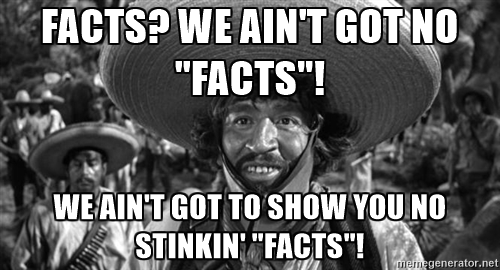
It is ironic – given how new-wave fascists lack the miniscule intelligence needed to appreciate irony – that they have for so many years decried liberals for their supposed “relativism.” It is clear enough, once you think about it, that these sorts of extremists have no clue what the word “relativism” might mean. But one way to break down the differences between conservative and liberal approaches to the world might be this: the conservative believes that there are fixed rules that one simply obeys, while the liberal believes that the world is a dynamic process which must be inquired into. Because liberals do not believe in such fixed rules, conservatives accuse them of believing in relativism. However, because conservatives do not believe in inquiry, they are the ones who actually practice relativism. Continue reading
03 Thursday Nov 2016
Posted in Critical Thinking, Endorsing Trump, Fascism, Green Party, Hillary Clinton, Jill Stein, Logic
DEFINITION: “Hillary Derangement Syndrome” (“HDS”)
The willingness to accept – without a first, much less a second thought – anything read or stated about Hillary Clinton, on no other grounds than that the thing read or stated is negative.
I’d rather hoped to avoid writing another political blog post for a while, but closing in on the election it is clear that the general insanity that has come to define (to the extent that it hasn’t strangled it in the streets) our community of discourse that is American politics, I find myself having to say one last word before the votes are all cast and counted.

Interior of Severalls Insane Asylum, something to look forward to in Trump’s America
One of the more despicable points of intractable dogma amongst so many “cry baby” progressives is that, “If we can’t get everything we want, exactly the way we want it, the instant we want it, then making things worse is actually making things better!” Now, few if any of such progressives (who are not all, or even a majority of progressives, by any means) will actually admit to embracing such a position, since doing so would require a level of intellectual honesty which they have rejected wholesale. Nevertheless, it is there, and it manifests itself as raving HDS that is often times even more singularly unhinged than what one finds on the right-wing of the political spectrum.
20 Thursday Oct 2016
Posted in Critical Thinking, fallacies, Genetic Fallacy, Logic
Tags
Where an argument comes from is not supposed to be relevant to the logical credibility of the argument, and there are named fallacies that highlight just such errors. (I’m going to talk loosely here, at first, so take the immediately following with a grain of salt.) The genetic fallacy says that where an argument comes from – its origins or “genesis” – should not be treated as relevant to the cogency of that argument. A somewhat more specific version of the genetic fallacy is a variant on the argumentum ad hominem, known as the tu quoque fallacy. “Tu quoque” basically means “you too,” or “you’re another.” The idea with this latter is rejecting the advice or argument of a person on the grounds that that person is doing the very thing she or he is advising against.
However, such a rejection is clearly not only unfair, but unjustifiable. An alcoholic may not be able to stop drinking, but is certainly in a position to understand the evils of that drinking, and present cogent arguments against it. Similarly, the nicotine addict, slowly suffocating from emphysema may not be physically or psychologically able to stop smoking, but said person is certainly well placed to understand the viciousness of doing so, and can offer extremely valid arguments against ever picking up the habit. But there are times when the source of a claim really is important, and needs to be taken into account when evaluating a claim. The probative value of evidence which we are not able to check ourselves often rests on the credibility of the source. The superficial version of the genetic fallacy that I presented above says that the source of a claim should not be given any weight, and that the argument should be evaluated by itself and on its own terms. But when we do not have complete control and/or mastery over those terms, then that source must also be taken into account. Continue reading
Cooking up food for thought & Shanarchy. I am a Philosopher, writer, meditation & mindfulness teacher, & artist.
Fencing / Sword Classes & Lessons Naples, Bonita, Estero, Florida
Loving Wisdom Beyond the Academy
 THE QUANTUM of EXPLANATION