Year of the Plague 3: Against Stupidity…

Tags

, , ,

the gods themselves contend in vain.i

The COVID-19 pandemic has proven to be a field day for the cognitively challenged; and the more galactically egregious the “challenge,” the more indefensibly extreme has been the response. Infantile stupidity in this instance seems to break out roughly into two major groups that roughly correspond to the origins of the novel coronavirus (these, in turn, seem overwhelmingly to take the form of conspiracy theories of one kind or another), the other major class being purported “cures” that vary from the semi-serious to the dangerously crackpot. The semi-serious versions have, at this time, almost all been shown to be dangerously crackpot when actually employed on any scale, so the difference is entirely a matter of degree rather than kind.gif-leslie-nielsen-nothing-to-see-here-2

Quite aside from the general disregard for trivially simple facts relating to the pandemic itself, these “source” and “cure” stupidities (one might even call them “before” and “after”) actively add additional layers of danger and risk to people’s lives. The “before” group, dominated as it is by conspiracy theories, is more than capable of singling out some one or few individuals as “the reason” for the disease. Such people can then have their lives torn apart by invasive internet searches and statements, inspiring acts of stochastic terrorism against purely innocent persons. Recall, for example, the self-appointed “hero” from North Carolina who traveled to DC with firearms to put an end to the non-existent child-trafficking ring Hillary Clinton was supposedly operating, the “basement” of a pizza parlor that had no basement. Nothing more than the bare, abstract possibility (never mind actual fact) of intelligence would have sufficed to see through the infantile nonsense of the whole “pizzagate” fabrication. But intelligence is never as sexy or exciting as the vicious lies that prop up conspiracy theories. Continue reading

Year of The Plague #2: Argumentum ad Ignorantiam

Tags

, ,

A recent article (23 March, 2020) by Eric Schliesser and Eric Winsberg (“S&W”) in The New Statesman: America, “Climate and coronavirus: the science is not the same,” attempts to make the case for separating climate science – specifically the facts about Anthropogenic Global Warming (“AGW”) – from the COVID-19 pandemic.i This pandemic is driven by the “novel coronavirus,” but I will stick to just “COVID-19.” Superficially, there is nothing wrong with wanting to do so since these are, after all, different topics. But just because the two subjects are non-identical does not mean that lively and effective analogies cannot be drawn between them. It is this last point that S&W wish to deny. Their attempt is specious on multiple levels, and I wish to address a few of those levels here.dollar sign

To address this speciousness, we must understand the nature of the argument that S&W are making.ii The abbreviated form of their argument goes something like this: (1) The facts about COVID-19 remain highly questionable, as the amount of data is severely truncated by lack of testing, and significantly variable methodologies of evaluations across international, and even local, lines. (2) This lack of data makes any comparison with, or analogy between, COVID-19 and AGW an error. (3) Further, the paucity of adequate data regarding COVID-19 requires us to view any and all such claims with great skepticism. (4) Such skepticism, in fact, that dramatic action which entails substantial economic impact ought to be rejected wholesale. Continue reading

Year of the Plague, #1

Tags

, ,

I have been away from this blog for a while now due to personal reasons that I’ll not discuss. It seems like it is time to pick it up again, as much for still other personal reasons that I’ll not discuss, as well as external realities that I will discuss. You can probably guess what my topic here will be, just from the title. From the number, you can safely infer that I anticipate more such posts in the coming weeks and months.

Corona Virus 1

As I write, Governor Pritzker’s “Shelter In Place” (SIP) order is scheduled to go into effect at 5:00 PM. (I live in Illinois.) As I already live an exceptionally quiet, sheltered-in-place life, Pritzker’s order has very little effect on me. I can still shop much as I always did, for all the things I would otherwise have purchased. The only difference for me is that now I will forward my shopping lists in advance for curbside pickup, rather than in-store browsing and purchasing. And this isn’t even part of the SIP, simply my choice to add an extra layer of caution. (A comprehensive discussion of Illinois’ SIP may be found HERE. The Chicago Tribune has waived its paywall for this story.) The biggest impact on my life will be the canceling of the in-person meetings of the Dungeons and Dragons game I was involved with.

As noted, I expect there to be a series of posts related to the novel corona virus and COVID-19 in the coming months. But this first shot out of the gate, I don’t plan to dwell on the metaphysics of pandemics, nor do I intend to rail against those steaming piles of maggot excrement who continue to spew indefensible twaddle about how “it’s only the flu!” I’m sure the times (plural) will come for that. No, this time I want to focus on my own, immediate intellectual and emotional reactions to the early stages of “all this.” This is for my own clarity of mind; writing it down helps me. Perhaps sharing it will help others, but I don’t know. Right now I’m just struggling to understand what I feel, what it means to me, to find myself living in this Year of the Plague. Continue reading

The Implicit “All”

Tags

,

One of the fundamental units in logical analysis is that function/operatori lovingly known as “the quantifier.” Most logic texts content themselves with just two: “all” and “some,” formally symbolized as “” and “” respectively. Thus, to say that, “All X is p,” one is asserting that every (or any) instance of X is also an instance of p, or is characterized by p, etc. Similarly, when someone says only that, “Some X is p,” the claim is made that, if one looks hard enough, one will find at least one instance where X is p. There are ways of precisifying (one of those $5.00 words philosophers love to use) the above statements, but there is hardly any need to do so here. It suffices to have a general idea. Two points I’ll mention in passing. First, in most formal contexts (substructural logics are an example of an exception), “all” and “some” are defined as being interchangeable using “not”: thus, “not-All X is not-p” is taken to mean “Some X is p,” and conversely. Secondly, these are not the only quantifiers possible: “many” and “most” are also examples. But these last two are difficult to formalize (to say the least) and by a polite convention among logicians they are generally ignored wholesale.Implicit All

As the title of this post states, I wish to talk about what I am calling the implicit “all”; uses of the “all” quantifier in which that quantifier is functioning but not explicitly stated. This happens quite often, in point of fact, and is not problematical in itself. Where problems do arise is when that usage is not merely implicit, but actively denied as a means of evading the consequences of what someone has actively stated or written. When this happens, we are faced not merely with a logical error, but an overt act of dishonesty. The dishonesty becomes not merely overt but blatant when, even after the implicit “all” is pointed out, the individual continues to deny it. Continue reading

Nonsense on Stilts

Tags

, ,

The Washington Post had an article in their science section a few days ago announcing “Scientists are baffled: What’s up with the universe?” It is a welcome relief to see mainstream reporting paying some attention to the massive problems that absolutely dog contemporary gravitational cosmology. One more frequently encounters a breathless declaration that this or that latest “discovery” “confirms” the Standard Model of Gravitational Cosmology (“SMGC”),i yet which then goes on to announce that we’ll need a “whole new physics” to make sense of this new data. (This article from The Guardian is slightly more balanced than many of the sources that later picked up the same story.) But the deeply problematic nature of SMGC is not really news, nor are the issues mentioned in the WaPo article even the most directly pressing matters. An extensive review of many of these problems may be found in the newsletters of the A(lternative) Cosmology Group. While a serious measure of background in mathematics and physics is required to read the listed and cited papers at any level of comprehension, a person with a basic background in these topics will be able to follow the newsletter discussions themselves and gain a modest acquaintance with the issues.Stilts

There are yet other issues that appear where SMGC intersects with micro-physics, in the realm of quantum mechanics. Part of the problem is that the mathematical bases of these two realms of inquiry – which, in the case of SMGC, is Einstein’s general theory of relativity (“GR”) – are built around radically different and largely incompatible kinds of mathematical structures: quantum mechanics, for all of its peculiarities, is linear in nature, while GR is fundamentally non-linear. This unification of the macro and the micro levels continues to defy serious scientific efforts, but the emphasis here is most definitely on “serious.” Unserious – because blatantly unscientific – efforts have given us the “string theory” nonsense which, while mathematically clever (at least by some accounts) is empirically vacuous, and as such devoid of any actual scientific content. Indeed, string-theory is so lacking in any basic scientific standing that not only is it empty of any actual empirical content, it lacks even the possibility of such content. Philosophers being disdained by the gate-keepers of SMGC – persons such as Brian Greene, Stephen Hawking, Neil DeGrasse Tyson, and Sean Carroll – one may also turn to the observations of scientists such as Lee Smolin and Peter Woit for confirmation of these statements. Continue reading

A = B

Tags

, ,

Anyone who is reading this post – indeed, anyone who can read at all – has some minimal exposure to mathematical ideas, even if that exposure goes no further than elementary arithmetic and not, as I am only half-jokingly known to say, actual mathematics. (Well, since I’ve mentioned it: the thing I’m known to say is, “that’s not mathematics, that’s arithmetic.” This is always in response to someone who has protested something along the lines, “I’m no good at mathematics; I can’t even balance my checkbook.” The humorous, yet legitimately educative nature of MY statement always strikes me as obvious, yet I am constantly amazed by the numbers of people who get lost in the elementary rhetoric of my statement.)A equals B

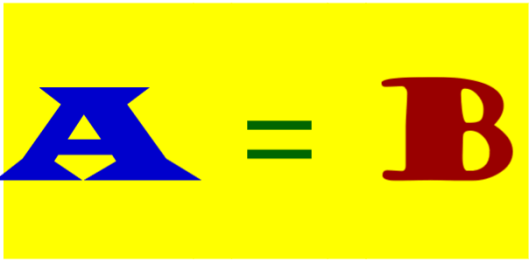
In any event, even such minimal exposure is typically enough to satisfy most people, even most mathematicians (I suspect), that they have a pretty good handle on what that equals sign (“=”) means as it is expressed in, say, the title of this little essay. Clearly I wouldn’t be writing about it if such an impression was even remotely true. For one thing, how do we read “A = B”? Does it say, “A equals B”, or does it say “A is B”, and is there a difference between those two? Spoiler: yes. Yes to both questions, depending on how crudely one is using one’s language, which makes the fact that “equals” does not equal “is” an especially problematic conflation of terms. “Is” tends to mean “identity” in such a context, which is tricky enough in its own right (I wrote an MA thesis on the subject). The reading of “=” as “equals” helps to emphasize a somewhat more functional approach to matters, though it is still more rigid and “substantive” than such formal notions as “equivalence” and “isomorphism.” topics I’ll likely blog about in the future because I can already hear the math-phobes screaming in horror. For now, I want to focus on the logical issues of “equals,” as a formal relation. Thus, the word “equality” may also find a use here, but that use should not be mistaken for the political, economic, cultural, &/or social senses of the term. (On the other hand, I do not preclude in advance that what I say here will have no bearing on those uses, either.) Obviously, the starting point for the primary discussion is with the work of Alfred North Whitehead. Continue reading

Pressure. Cooker.

Tags

, ,

My limited, and very humble, cooking experiences have never involved a pressure cooker. However, I do understand a little about how they function and why they are used. For many dishes, it suffices to permit the steam generated by cooking to pass out of the cooking vessel, and permit the food to otherwise be finished by ordinary methods of heating. But some recipes require that the food be cooked in a more intense manner: the steam that might otherwise be released unused into the indifferent world are instead contained under pressure, and that pressure in turn forces that steam back into the food, to provide an especially deep, internal, and unremitting form of cooking. This is all just physics, lacking the resources and the motivation to attempt such recipes, I’ve no idea what the process or products actually look like. My motivation for mentioning it is quite different from culinary compositions.Pressure Cooker

Cooking is often used as a basis for metaphors for human psychology. For example, a person who is “fried” or “baked” is someone who is exploring better living through chemistry. “Scrambled” is great for eggs, but speaks to a chaotic and disorganized state of mind in a person. Steamed vegetables have a happy crunch, but a person who is steamed is likely to be poor company. So the effect on the person is often taken from the effect on the food, rather than our enjoyment of that effect. (Presumably, the vegetable derives no joy from being steamed.) But the usefulness of such metaphors is always limited, and sometimes just genuinely wrong. Such can be the case with pressure cooker images. Continue reading

The Sisyphean Dot

Tags

, ,

The myth of Sisyphus and, in particular, Camus’ reading of that story, are obviously on my mind. Having mentioned the story in my last post, I want to say more about it here, only in the context of process metaphysics.

And cats.

Red Dit

Cats, you see, are either the worst or the best existentialist philosophers. The difficulty in answering this question is not because they are cats, but because of all the labored verbiage that goes into saying what existentialism is. Indeed, where I want to take this argument is in the direction of undermining that last phrase. Existentialists say that the world is absurd, but much of that claim turns on the use of that annoying little verb “is”. Sartre, for example, named his magnum opus Being and Nothingness, with the first half of that title emphasizing the root verb (“to be”) from which all forms of “is” emerge. If the focus of existentialist thought is directed upon “being” and forms of “is-ness,” then much of existentialism’s claims of absurdity stand or fall upon the priority given over to the word “is.” If so, then even asking the question, “what existentialism is” could well be a fundamental error that many existentialists themselves commit. So the direction of our discussion here is this: to gloss Camus’ famous essay “The Myth of Sisyphus,” illustrate some salient points using cats, and segue finally into how the whole thing gets reimagined in a process metaphysics. Continue reading

The Myth of Technofix

Tags

, ,

On a more or less regular basis, some wild-eyed enthusiast in a lab coat will get his name – and by my account, they’ve all been men, the reasons for which will become evident as we proceed – in the media by proposing some massively destructive campaign of crapping all over the global environment in order to “save” it from AGW (Anthropogenic Global Warming). In order to make such a deliberately manufactured catastrophe sound respectable, it is given a fancified, multi-syllabic name: geoengineering. According to these well-paid (male) lab-coats, the way to make things better is to make them unimaginably – and, most terrifyingly – unpredictably, worse. One is reminded of the enthusiastic, lower-level Air Force PR officer who effused to the press how it was necessary to destroy some particular Vietnamese village in order to “save” it. These days this isn’t even recognized as ironic. One is also reminded of the nursery rhyme about the Old Woman Who Swallowed a Fly. But getting people to recognize an obvious analogy is almost as distressed a program as getting them to notice irony.Sisyphus

Now, everyone who isn’t intransigently stupid, viciously dishonest, or some combination of both, has long since recognized the reality of AGW. Gee golly willikers, it was cold in some places in North America this Winter. Well, given that we’re talking about less than 1.84% of the entire surface of the Earth, a person might feel justified in asking if there might just possibly be a difference between GLOBAL warming and “your backyard” warming? Or again, the fact that the destabilization of the winter jetstream that leads to the “polar vortex” is itself a consequence of global warming, as unparalleled warmth moves into the Arctic and pushes relatively cold air South, is not one of those arcane secrets that gets hidden away in books, so that the denialists will never find it. So, the question is: What do we do about it? Continue reading

Measure is The Measure of All Things

Tags

,

The online journal Eidos, A Journal for the Philosophy of Culture has just published a focus issue (#4 (6)/2018) on the topic of “Philosophy and Technology,” in which yours truly has an item. The title of my contribution is the same as this blog post, and it, along with all the other articles, is free for the download. It is a “discussion paper”, which means it is permitted a bit more leeway when it comes to scholarly standards of argument and citation. At some 6,000 words it is a good 4+ times larger than my longest blog posts, but it is free and possibly even interesting; at the very least it is at the same general level of readability of my regular blog posts, so folk who are interested can download it HERE.Robot

The entire journal may be accessed from the Eidos link above, and is well worth checking out, both for this current issue (table of contents reproduced below) and for the back issues that can be accessed through the link to the archives. As mentioned, this issue is about philosophy and technology approached, as one might guess from the journal’s title, from the general position and environment of questions of culture. Some folks might be surprised at such a choice of philosophical topics, as technology might not seem on the surface to have much to do with “the true, the beautiful, and the good,” the supposedly “core” topics of philosophy. But a couple of sentences from Marcin Rychter’s opening editorial struck me as quite appropriate here:

A simple conclusion seems inevitable: we can neither understand ourselves nor our times without deeply thinking about technology. A stronger claim seems plausible: technology should be the main topic of contemporary philosophy of culture.

Continue reading