• About me (Gary L. Herstein, Ph.D.) / Contact form
  • Furious Vexation (general questions here)
  • Statement of Intent
  • With regard to Comments and Spam

THE QUANTUM of EXPLANATION

~ Science, logic, and ethics, from a Whiteheadian Pragmatist perspective (go figure)

THE QUANTUM of EXPLANATION

Category Archives: Logic

Scholarship and Public Responsibility

24 Thursday Dec 2015

Posted by Gary Herstein in Critical Thinking, Logic, On Bullshit, Public Philosophy

≈ 3 Comments

Tags

academia, Critical Thinking, Public Philosophy

The title addresses scholarship in general, but I will direct my remarks specifically toward philosophy, as that is the scholarship I am most familiar with.

Certainly it is the case that being a public person is a kind of exposure that is often uncomfortable for everyone. But the issue here is not what makes you cozy, but what fulfills your responsibilities.flasher

In a recent essay in The Guardian, James Mulholland offers what I find to be a deeply flawed argument against the idea of academics taking serious steps to make their work accessible to the broader public. Within my general academic area, this is known as “Public Philosophy.” Mulholland insists that, “It is time for us to reassess what we mean by public scholarship. We must recognise the value of the esoteric knowledge, technical vocabulary and expert histories that academics produce.” This is in the context of a world where, Mulholland tells us, “Academics are constantly encouraged to engage with the public more often,” advice which he rejects because, he insists, “this advice ignores the way that specialised knowledge already affects civic life. Specialisation has social importance, but often only after decades of work.”

Hearkening back to a quip by Heinlein, I might also add that, “Specialization is for insects.” Continue reading →

It Isn’t a Fallacy If It’s True

15 Tuesday Dec 2015

Posted by Gary Herstein in Authoritarians, Critical Thinking, Donald Trump, Fascism, Logic

≈ 16 Comments

Tags

Critical Thinking, Donald Trump, Fascism, Michael Kazin

Actually, it isn’t a fallacy if it is true and relevant, but that makes for a rhetorically clumsy title. The fallacy I want to talk about here is the argumentum ad nazium (sometimes called ad hitlerium.) This is the “fallacy” of dismissing some person or group as being Fascists or Nazis. We’ve certainly seen a great deal of this in recent years, with President Obama repeatedly denounced in the right-wing media as a Fascist communist Muslim Kenyan/Indonesian (with a time machine to fake his Hawaiian birth certificate.) These accusations are just part of the flood of infantile twaddle that organizations like Fox “News” butter their bread with. But what if someone in the public sphere – for example, running for national office – really is a Fascist?Fascists

There are many memes flowing through social media comparing Donald Trump to Hitler. I disagree with these comparisons somewhat, and a glance at the attached picture will indicate the nature of that disagreement (the specifics of THAT disagreement will not be explored here.) I will argue that it is both true and relevant to characterize Trump as a Fascist. However, before proceeding with that particular claim, I will spend most of my time talking about Fascism itself. This concept gets thrown about with promiscuous abandon, and the general disregard for what it really means is a disturbing sloppiness for which I have no sympathy. Continue reading →

How to Lie with Questions

30 Monday Nov 2015

Posted by Gary Herstein in Authoritarians, Critical Thinking, Logic, Politics

≈ 5 Comments

Tags

Authoritarians, Critical Thinking, Politics

Many people labor under the erroneous assumption that questions are essentially innocent. To the extent that this is true, these people open themselves up to a kind of manipulation that is insidious to the point of being vicious. The asking of a question – any question, really – presupposes an enormous amount of background information in order for the question to even be meaningful, much less answerable. When that background information assumes as given fact matters that are in reality untrue, then the fallacy of the complex question has been committed. Groucho Marx famously posed the question, “Are you still beating your wife?” But this question cannot be answered unless it is first true that the person being asked is, or at least was, a wife beater. But if that condition is not true, then there is no way of answering the question, since either a “yes” or a “no” answer amount to the assertion of a falsehood. Which is to say, in answering a question, one is tacitly agreeing to the background assumptions.Groucho Wife

One can be at once variously innocent seeming, and yet aggressive, in how one poses a loaded question, depending on how utterly lacking in integrity one happens to be. Thus, for example, in politics one often encounters what is known as a “push poll.” Disguised as a questionnaire, a push poll’s real intent is not to learn what people believe, but to actively manufacture that belief. The seeming innocence of the push poll is in its sheep’s clothing as a questionnaire; the aggression comes in the implicit posturing as essential democratic process: failure to answer the question is a failure to participate in democracy. Which brings me to the Congressional Representative for my district in Illinois, Mike Bost. Continue reading →

Rhythm and … Logic?

30 Monday Nov 2015

Posted by Gary Herstein in Aesthetics, Critical Thinking, Logic, Mathematics, Whitehead

≈ 14 Comments

Tags

Aesthetics, Critical Thinking, mathematics, Whitehead

There’s a false dichotomy which supposedly stands between aesthetics and analysis. But art and emotion do not stand in opposition to logic and reason. This nonsense is, in many ways, the bastard offspring of the “two cultures” story we’ve inherited since before C. P. Snow gave it a name, and which we’ve variously integrated into our teaching programs for almost all levels of education. Back in the “good old days” of classical education (by which I mean the ancient Greeks) mathematics and music were treated as much the same thing. Even today, we have not quite lost all sight of those connections, and if one takes the time to listen to mathematicians, one will notice that the issues of whether a proof or a theorem is beautiful or not takes on primary importance.DrumStickNylonPic

http://www.youtube.com/watch?v=1XWlK-cL504

Careful, meticulous reasoning is not cold; quite the contrary, it is a fire that will consume you without mercy. I’ve touched on the idea of mathematics and the beautiful before, but wish to revisit the idea again because it can bear the company, even in this Thanksgiving season. This time around, however, I wish to approach matters from a more “musical” perspective that specifically highlights some ideas around “rhythm.” I mean to tackle these ideas from what I take to be a very Whiteheadian point of view. Whitehead was, of course, an accomplished mathematician and educator, and well attuned to the subtleties of mathematical aesthetics. But as he began to worry about the philosophical underpinnings of our physical sciences, his inquiries began to lead him from issues of organization (of thought) to organism itself. Rhythm became one of Whitehead’s central concepts. Continue reading →

Test

20 Friday Nov 2015

Posted by Gary Herstein in Critical Thinking, Inquiry, Logic

≈ 8 Comments

Tags

Critical Thinking, Narrative

This post can be viewed as a companion piece to my one about “proof.” Proof is a kind of test to which a certain, rigidly constrained, set of ideas can be subjected. While it is important within that limited context, proof mostly stands out as an all-but-unachievable ideal, the kind of ideal that suggests the outside limit for the types of tests that might be applied to ideas, concepts, claims, hypotheses, and so forth. There are a great variety of such tests, and they do not line up along a single unimodal, univocal spectrum. But it does seem to me that they do converge at the far ends of this lattice, this partially ordered set of possibilities, to proof as the highest ideal at one end, and vapid opinion, as the most dispensable example at the lowest (and, sadly, commonest) end.Test F

There are primarily three families of tests for ideas, and each such family breaks out in a variety of ways: logical coherence, empirical adequacy, and narrative intelligibility. Following Whitehead’s argument in the early pages of Process and Reality, I take “logical coherence” to be something that is vastly larger than just proof-theoretic completeness or model-theoretic semantic sufficiency. Both of these latter are formal ideals, part of the above, generalized concept of “proof,” that seldom realize themselves in the real world. Logical coherence is not such a desiccated abstraction; rather, it is the requirement that ideas “hang together,” at least “locally” (in metaphysics, this requirement becomes “globally.”) Continue reading →

The Least of These

19 Thursday Nov 2015

Posted by Gary Herstein in atheism, Ethics, God, Logic, Syria

≈ 4 Comments

Tags

Authoritarians, Ethics, God

I am not a religious person, a fact I’ve never hidden from anyone. However, I’ve also made it clear that I am impatient with “lazy atheism” – cheap shot forms of willful ignorance that make no effort to grasp the differences between religious, theological, and philosophical concepts of “god,” or the many nuanced ways in which such a being might creatively interact with the world. Just because you watched five minutes of Pat Robertson on the television does not mean you are an expert on the subject – not even on the subjects of religions as these are practiced, in fact, by people, much less the full range of concepts, both actual and possible, relating to “god.”

syrian-refugee_1

But if lazy atheists are tedious, lazy theists are downright disgusting. I’ve never invested the effort to actually study the Bible, but I did read large portions of it when I was a child. So when my knowledge of this collection of texts exceeds that of persons who publicly posture themselves as devout Christians, I am disinclined to treat such people charitably.

It is my unscientific impression that these persons – willfully ignorant yet declared devout Christians – are invariably conservatives of an extreme variety.

The liberal Christians I have met (and, again, this is not a representative sample) have not only been less inclined to make public displays of their religious beliefs, they have been much more interested in learning and discovering new and different aspects of religious beliefs in others. The difference here may well be due to the fact that conservatives are much more inclined toward adopting authoritarian mind frames, to the extent that not only are they less interested in learning new things, but they are often positively opposed to permitting others to do so.

So it is that I cannot tell if it is ironic, or merely pathetic, that the noisiest opposition to the admission of a handful of Syrian refugees (a “handful” in comparison to the staggering numbers of them) to the United States, seems universally to be coming from conservative “Christians.”

44″Then they themselves also will answer, ‘Lord, when did we see You hungry, or thirsty, or a stranger, or naked, or sick, or in prison, and did not take care of You?’ 45″Then He will answer them, ‘Truly I say to you, to the extent that you did not do it to one of the least of these, you did not do it to Me.’

Mathew 25: 44 – 45

People “Needing” People

15 Sunday Nov 2015

Posted by Gary Herstein in Logic

≈ Leave a comment

Terrorist attacks are not intended to make us stop what we are doing; they are intended to make us do the worst that we are doing and do it more.

The aim of terrorism is not to bring the “other” to surrender, but to bring the “other” to become the thing it despises the most: to become indistinguishable from the terrorists.

KONICA MINOLTA DIGITAL CAMERA

This is why 9/11 was an unqualified success for al Qaeda. Not because of the people it killed — we slaughter far more on an annual basis with our own guns than died the one time in those towers.

9/11 was an unqualified success for the terrorists because it convinced us to become even worse than they were.

I suspect — though I can offer no other evidence than such grasp of human psychology as I possess — that the ultimate purpose of the Paris attacks was to create exactly the hysteria toward refugees that it created.

ISIL’s primary resource is NOT the oil it sells on the black market, but the people it controls, enslaves, and terrorizes. The flood of refugees was hemorrhaging that primary resource. They may now have effectively stopped that.

I have no words

13 Friday Nov 2015

Posted by Gary Herstein in Logic

≈ 1 Comment

http://www.drmartinlutherkingjr.com/birminghamchurchbombingeulogy.htm

Proof

12 Thursday Nov 2015

Posted by Gary Herstein in Logic, Philosophy of Logic

≈ 7 Comments

Tags

Critical Thinking, Logic

Nine times out of ten (probably closer to ninety-nine times out of one hundred) when someone starts talking about, much less demanding, “proof” – proof of anything – unless they are discussing whiskey[1], they almost certainly have no idea what they are talking about. This is especially true in the empirical sciences, where various anti- or pseudo-scientific quacks, climate change denialists, creationist ideologues, and others like them, will insist that the fatuous twaddle they are spewing is perfectly reasonable since, after all, they (the quacks) have not been “proven” wrong, while the actual scientific literature has failed to absolutely “prove” its case. These claims are so childish that one must almost wonder if the denialists and others like them might actually know that what they are saying is not just bullshit (that last being a technical, philosophical term), but an outright lie. I am myself, however, disinclined to assign a level of intelligence to people to pull off such a clever conspiracy when nothing else in their lives gives any evidence of such nuanced and incisive reasoning. As a very loose and general rule, people are far for likely to have no idea what they are talking about, as opposed to talking about it very cleverly.Rum Gone

The idea of proof in mathematics (the only venue where non-liquor related uses have any meaning) had become so vexed by the end of the 19th Century, that the field of mathematical logic was, in essence, invented with the purpose of sorting matters out. Matters kept resisting being sorted, and along the way the nose of the mathematical camel got into the philosophical tent, and ended up swallowing philosophical logic whole for some decades that followed. Even today, the issue of how to teach logic, and what logic to teach, has not been particularly well sorted out in philosophy. So what might be said about the nature of proof, such that we do not have to become facile with mathematics, yet can still avoid being gulled by credulously accepting demands for, or putative statements of, proof? Continue reading →

Philosophical Explanation

04 Wednesday Nov 2015

Posted by Gary Herstein in Critical Thinking, General Philosophy, Logic

≈ 4 Comments

Tags

Critical Thinking, General Philosophy, Logic

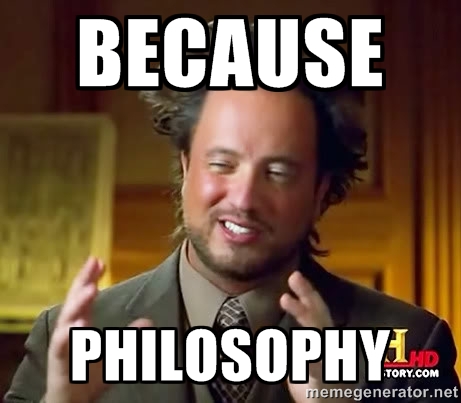
It strikes me that I’ve said very little about the nature of philosophical explanation, even as I write from a specifically philosophical perspective and intent. This might qualify as ironic, but I’m never confident that I’m using the word “irony” (or its variants) properly. Which, for a man with my education, might also be ironic …Because Philosophy

I’ve written a number of posts variously exploring the nature, the expectations, and a few of the pitfalls surrounding scientific explanations. I’ve probed a few ethical/moral issues, and even discussed some fairly generic questions around the large scale issue of the “logic of inquiry” itself. But beyond a few scattered comments, I’ve not really posed the question (along with a tentative answer) about the nature and value of specifically philosophical inquiry itself. This post will be my first concerted stab in that direction. Continue reading →

← Older posts
Newer posts →
Follow THE QUANTUM of EXPLANATION on WordPress.com

Enter your email address to follow this blog and receive notifications of new posts by email.

Blogs I Follow

  • Homotopy Type Theory
  • The Shanarchist Cookbook
  • Cote du Golfe School of Fencing
  • Professor Watchlist redux
  • Free Range Philosophers
  • thenonsequitur.com
Whitehead, Alfred North

Copyright Announcement

© Dr. Gary L. Herstein and garyherstein.com, 2014 -- 2024. Unauthorized use and/or duplication of this material without express and written permission from this site’s author and/or owner is strictly prohibited. Excerpts and links may be used, provided that full and clear credit is given to Dr. Gary L. Herstein and garyherstein.com with appropriate and specific direction to the original content. (In other words, share but acknowledge.)

← Back

Thank you for your response. ✨

“But in the real world it is more important that a proposition be interesting than that it be true. The importance of truth is, that it adds to interest.” – Alfred North Whitehead, Process and Reality

Archives

Spam Blocked

71,382 spam blocked by Akismet

Blog at WordPress.com.

Homotopy Type Theory

The Shanarchist Cookbook

Cooking up food for thought & Shanarchy. I am a Philosopher, writer, meditation & mindfulness teacher, & artist.

Cote du Golfe School of Fencing

Fencing / Sword Classes & Lessons Naples, Bonita, Estero, Florida

Professor Watchlist redux

Free Range Philosophers

Loving Wisdom Beyond the Academy

thenonsequitur.com

  • Subscribe Subscribed
    • THE QUANTUM of EXPLANATION
    • Join 123 other subscribers
    • Already have a WordPress.com account? Log in now.
    • THE QUANTUM of EXPLANATION
    • Subscribe Subscribed
    • Sign up
    • Log in
    • Report this content
    • View site in Reader
    • Manage subscriptions
    • Collapse this bar
 

Loading Comments...