What a math …

Tags

, ,

So I did a thing …

Get your mind out of the gutter, it was nothing like that. I did a presentation at the Personalist Forum conference, which happened to take place fairly close to where I live. (Normally it is at Western Carolina University, but due to scheduling conflicts had to be moved.) This year’s venue was at the American Institute of Philosophical and Cultural Thought, here in Southern Illinois. The topic is about learning the basic tools needed to genuinely follow Whitehead’s thought. The title is Learning the “Language,” where ‘language’ is very deliberately scare quoted.

This talk came hard on the heels (as opposed to “heals,” though that too is relevant in an ironic way) of a major surgery I’d just been through. While complicated enough under the best of circumstances, my procedure proved to be especially difficult. By all estimates, I came through it with flying colors, but I was still quite punchy at the time I made my presentation. I mention this in the talk.

I do word stuff with my mouth.

That being said, it came off quite well. The subject is “close to my heart,” as it were, and even working from nothing more than an outline I was able to present my case. As I say in the talk, my hope is and remains that the failings of the presentation and the presenter do not mask the fact that there is a legitimate issue and complaint involved in much of existing Whitehead scholarship. Below is the suggested reading list I handed out at the talk, which I’ve expanded a little for this blog post.

As a rule, I despise pictures of myself, and find videos simply unwatchable. I did finally watch this one, and it is less execrable than one might otherwise suppose.

Suggested Readings

Habit of thought:

Alfred North Whitehead, Principles of Mathematics (New York: Henry Holt, 1911.) Free for the download from Project Gutenberg, https://www.gutenberg.org/ebooks/41568

Philip J. Davis and Reuben Hersh, The Mathematical Experience (New York: Harper Paperbacks, 1999.) This book really cannot be praised enough, a book that everyone should read regardless of their interest in Whitehead.

Morris Kline, Mathematics for the Nonmathematician (Mineola: Dover Books, 1985.)

George Polya, Mathematics and Plausible Reasoning, vol. 1 & 2 (Princeton: Princeton University Press, 1990.)

Thomas Tymoczko (Editor), New Directions in the Philosophy of Mathematics (Princeton: Princeton University Press, 1998.) Part of the effort to understand mathematics as inquiry, rather than set theory done badly.

Hermann Weyl, Symmetry (Princeton: Princeton University Press, 1981.) One of those books that earns the label “classic,” this introduces some of the essential characteristics of group theory without getting into a lot of mathematics.

History:

Edna Kramer, Nature and Growth of Modern Mathematics (Princeton: Princeton University Press, 1981.) For my money, hands down the best general history out there. So of course it is out of print, impossible to find, and insanely expensive.

Morris Kline, Mathematical Thought From Ancient to Modern Times, volumes 1 – 3 (Oxford: Oxford University Press, 1990.) Pretty good, and at least it can be had without mortgaging your first born child.

Leo Corry, Modern Algebra and the Rise of Mathematical Structures (Basel: Birkhäuser, 2003.) This is an outstanding book, delving into the origins and problems that led to the emergence of abstract algebra, from the 1820’s to the 1940’s. Whitehead is discussed, but not very closely. Still, the nature of abstract algebra is developed in its historical context to a degree not available anywhere else. By my standards, the book is on the pricey side, but still well worth the investment

Abstract Algebra:

There are plenty of good books out there. The trouble is that it is quite difficult to get your head wrapped around the topic w/o some kind of mentor (i.e., math professor) there to help you out. Keep in mind that math books are the hardest to copy edit, because the editor must be as good at math as the author (which never happens.) So you’ll find yourself up against a wall where you’re wondering if you simply don’t understand what’s being said, or if there’s a typographical error in the text. I solved the problem by getting an MA at DePaul.

But if you want to give it a go on your own, most any intro book from Dover will do:

https://doverpublications.ecomm-search.com/search?keywords=abstract+algebra

Special mention for:

Nathan Jacobson, Basic Algebra, vol. I & II (Mineola: Dover Publishing, 2009.) These two volumes are exceptional for their comprehensiveness. I originally acquired these books as first edition hard covers, back when a hard cover cost a little less than a new car. I liked them well enough that when I discovered that Dover had them as eBooks I purchased them again so that I’d have a copy on my kindle. Be warned, though: the “basic” in the title is a tad misleading. These are the books that convinced me I needed to return to graduate school to learn abstract algebra.

Happy-Fluffy-Touchy-Feely-God-Talk

Tags

, , ,

Or

How a Vine can Kill a Tree

There is a certain group of scholars – I’ll name no names – which has taken on such a dominant position in Whitehead scholarship (at least, within the US), that one could arguably characterize their position as “hegemonic.” I have personally met a number of individuals associated with this group, whom I’ll simply call “The Group,” and freely admit that they are, as individuals, fine, generous, and altogether excellent folks. My complaint here – and I will be complaining rather sharply – is not with any of them as particular persons, but rather with the hegemonic direction in which The Group has taken Whitehead scholarship. That direction is what I am calling “Happy-Fluffy-Touchy-Feely-God-Talk” (HFTFGT from now on.)

Now, there is no question that Whitehead spoke of “God” extensively in his writings. Many people have the devil’s own time with such talk, those whom I’ll often characterize as “Ouchie Atheists,” for whom any such discussion drives them either into a fury or else into something like a cognitive anaphylactic shock. (Sometimes both.) This is one of the lesser pities of our day and age, a consequence of neo-fascist Christian Dominionist fundamentalists having hijacked the word and all discussions thereof. It is additionally unfortunate with regard to Whitehead scholarship because his use of the “G-word” could easily be replaced throughout his text with the Greek word “arché,” which would eliminate at a stroke the difficulties the Ouchie Atheists have and (arguably, at least) make it possible for them to dive more deeply into Whitehead’s texts and arguments. But Whitehead was intransigent in his refusal to employ non-English words. “Atom” was an exception. Though it originated with the Greeks, it had by his time – both by convention and courtesy – been thoroughly adopted as “English.” This is a little ironic, since contrary to most physicists of his day, Whitehead continued to use it in the original Greek sense of “a-tomos,” meaning “uncut.” So an atom for Whitehead was not a microscopic corpuscle, but an undivided whole which could be of any size.

I like the word “arché” because it can be translated as “foundation/font,” and this is what Whitehead meant by “God”: the rational foundation of reality, and the font of creativity. (This latter is one of the things that distinguishes process philosophies from static, substance based ones: the universe is a process of creative advance.) Notice that I do not suggest the Greek word for “god,” “theos” (or possibly “theou,” my Greek is not very good.) This is a deliberate choice, readily justifiable by even a moderately close reading of what Whitehead actually says, particularly within the pages of his masterwork of metaphysics, Process and Reality (PR).

With, however, the exception of one sentence.

This sentence appears in the last few pages of PR, which are separated from the rest of the volume as Part V. The language and argument of this final, very short “part” is fundamentally different from the preceding hundreds-plus pages of text, and this radical difference has led some to wonder just how genuinely integral an element of the rest of the discussion it truly is. In these final, very few pages, Whitehead allows himself to slip into more poetic language, most particularly with the above mentioned one sentence – which I’ll not quote. (If you know, you know, and if you don’t you’ll recognize it instantly should you ever read PR to the end.) But members of The Group, and others sympathetic to their program, latched onto that one sentence and ran with it. They ran fast, long, and hard, and are still running. From this we get the HFTFGT of process theology.

And it has swallowed the scholarship whole. So much so that Whitehead’s triptych of 1919 – 1922 (Enquiry into The Principles of Natural Knowledge, The Concept of Nature, and The Principle of Relativity with Applications), a revolutionary re-evaluation of the entire philosophy of nature, have largely vanished from the canon of Whitehead’s works that are studied. (Let me reiterate that this is within the US. Chinese scholars, for example, recently celebrated the centennial of those works with no fewer than three separate conferences, one for each book.)

Even those works of Whitehead’s that do receive some attention receive it only selectively. Thus part IV of PR, for example, is often skipped over and ignored with students sometimes being told to ignore it because it is “irrelevant.” One might, alternatively, point out that part IV is the beating heart of Whitehead’s entire relational system, where he presents his mature mereotopology, his non-metrical theory of curvature (“flat loci”), his subtle theory of physical connectedness and causality (“strains”), his completed theory on the internalization of relatedness as the flipside to the theory of the externalization of relatedness found in part III, etc. But part IV also involves a lot of logical and mathematical thinking “stuff,” and so one can just skip over that because it doesn’t feed into HFTFGT. A more cautious reader might suspect that what this rather demonstrates is that it is HFTFGT that is flopping around looking for relevance. But such cautious readers are not being invited into the club, and their professors are not encouraging their students to adopt such cautious approaches.

It is partly as a result of this narrow and eminently disputable presentation of Whitehead’s philosophy that many outside the field who might otherwise profit from engaging with Whitehead’s ideas (especially persons in the sciences), explicitly reject the notion out of hand. Because, after all, Whitehead is “nothing more than” a lot of HFTFGT. And people “just know this to be the case” because they are constantly and loudly reminded of this “fact” by those experts who are only interested in HFTFGT.

(Of course, persons in the physical sciences tend to reject any suggestion of engaging in philosophy because it is, after all, philosophy. They often do this as they explicitly engage in philosophical discourse; and do so badly.)

Such a reductionist caricature of Whitehead’s thought is, of course, the worst sort grotesquely fatuous twaddle imaginable. Let me repeat, Whitehead wholly re-imagines Nature in a relationally robust and holistic framework that is original, insightful, and logically rigorous. But consider in comparison what your grasp of Christianity might be were it the case that all you ever heard about it came from the neo-fascist Christian Dominionist fundamentalists. Your idea of Christ would look more like Adolf Hitler. (By the bye, in contrast to the neo-fascists, the advocates of HFTFGT promote a vastly more Christ-inspired vision of God and the gospels that is genuinely loving and caring for ALL of creation.) And so it becomes increasingly difficult to even suggest to people who are not already heavily, even exclusively, invested in HFTFGT to cast even a casual eye on Whitehead’s work.

Which brings us to the matter of how a vine can kill a tree.

There is a method of killing a tree called “girdling.” A tree grows out as well as up. But if something is tightly bound around the outside of the trunk (it is “girdled”) the tree can no longer grow outwards. And it is these outer portions that carry the nutrients up the trunk to the rest of the tree. So the effect is like a garrote.

A vine is capable of girdling a tree. There is no malevolence involved, no ill or predatory intent; but the effect is the same. This is what ‘The Group’ is doing, I would argue, to the larger tree of Whitehead scholarship. (One of the ironies here is that they themselves are being girdled by the neo-fascist Christian Dominionist fundamentalists, who deny that liberal – never mind process – theology even qualifies as Christianity, or as anything other than the work of the Devil, even though this form of “devilry” is demonstrably truer to the Gospels. But just try to find someone who is not already an expert in the field who is even aware of the existence of process theology.)

I don’t want the HFTHGT people to go away, but I would like to see a serious effort on their part to acknowledge that their project emerges from a vanishingly small corner of Whitehead’s work. I don’t want to chop down the vine, but I would like the vine to stop strangling the tree. This would include exercising some genuine circumspection about what they attribute to Whitehead, as opposed to what they themselves rather freely speculate about, far beyond anything he – in his meticulous, mathematically rigorous and disciplined way – ever pretended to entertain.

Limits of Reason, 1.X … rev Ϡ

Tags

, ,

Yes, I have been away from this blog for a long time. No, I am not going to talk about that.

I’ve been thinking a great deal about the connections (possible and otherwise) between various aspects of theoretical computer science, and reasoning in general and empirical science in particular. When I talk about “theoretical computer science”, I definitely do not mean applied problems such as the rendered graphics in an FPSRPG (and that shot most assuredly DID hit, you cheating bastards!) No, I mean the mathematical and logical puzzles associated with what it is possible to compute, in the absolute limit of possibility, and what (among that collection of puzzles) can be reasonably computed given the physical and temporal constraints of the universe.

Computability: What can or cannot be computed, period. For example, can you write a program that will test all other programs to see if they run. Absolutely not! Take the program itself, flip a few relations, and then feed that to itself and you will force it into an infinite loop that it cannot solve. Due to the logician Alonzo Church, this is known as the “Halting Problem.” One of the favorite ways of demonstrating a problem is unsolvable is by proving its solution would also solve the Halting Problem.

Say Goodbye, It’s Independence Day.*

Tags

, ,

*(A line from a Springsteen song, in case you didn’t know.)

With the “Supreme” Court and it’s viciously ideological rightwing members now stampeding the United States full-tilt to all-out fascism, there is little to celebrate this July 4th. Even if Trump does not run or does not win (for whatever reason, including federal indictments), even if, by some incomprehensible miracle, the moves the court will make in its next session do not entirely erase the majority of voters voices from our political enterprise, matters remain dire.

It is clear that the overwhelming majority of the Republican party has abandoned any pretense of decency, of reason, and most certainly of democracy. Absent a series of what appears, as of this writing, to be highly unlikely events, the experiment that was the United States is done for. So, on this holiday, I leave you with these “postcards.”

(I add this last one for those who think there’s no difference between the two.)

So this evening while you’re testing your luck at whether or not you blow your hand(s) off, and terrorizing the dogs, cats, birds, veterans with PTSD, etc, in your neighborhood with explosive devices, perhaps cast a thought to little things like the Declaration of Independence and the Constitution of the United States, and whether these things actually matter to you, or if all you care about is feeling good about white supremacism and other fascist instruments of hegemonic domination.

This Is Not a Person Either

Tags

, , ,

This has been hard for me, getting to this place.

Getting to this place where I can write.

Getting to this place where I can write what is obvious.

It is not an accident that within a matter of a couple of days, this “Supreme” court has viciously curtailed human rights while indefensibly expanding gun rights. But take a look at the picture below. Look at it carefully. This is not a person.

This is a variant on the AR-15 assault rifle. Infantile purists will delaminate if you say “AR” stands for “assault rifle.”

But if you are a woman, if you are non-binary, LGBTQIA+, it basically has more rights before this court than you do. In other words, before this court, you are not a person. Add BIPOC to the previous list, because unless you are white and male, if you go parading around with an assault weapon you are unlikely to be allowed to survive, never mind pass unharrassed, by our massively militarized Law Enforcement.

This is NOT a Person 1

Tags

, ,

With the savagely ideological “Supreme” Court prepared to erase the rights of actual human beings on on no other account than that they are women (and consequently, don’t count), it seemed like a timely moment to set down my other projects and cast an eye upon the subject of abortion. Now, Whitehead himself never addressed the topic, so no pretense can be made to declare what his thoughts on the subject might have been. We can say, however, that his personal conclusions, were he to have any, are not really relevant here, as we want to develop a view of the subject within the context of process metaphysics, and not any one scholars individual declaration. That being said, it must also be added that other ways of working out conclusions other than those offered here will also be possible within the stated domain.

First off, what is a “person”? We should immediately drop any thought of conflating “person” with “human being.” “Properly developed” human beings seem clearly to be persons, but not all persons will be human beings, developed or otherwise. Non-terrestrial intelligences, for you science fiction enthusiasts, are clearly persons without being human. But many would argue that terrestrial non-human animals are also persons, deserving of our care and ethical considerations. These (humans) would be those variously involved in animal rights activism and concerns. It is a tricky subject that I’ll not pursue here, though I admit to being a little troubled by my failure to embrace vegetarianism. I’m sure you’ll have noticed by now that I’ve not tackled the previous scare-quoted qualifier “properly developed.” I promise, we will get back to that.

But more needs to be said about “person.” A person is an agent, and an agent is something capable of intentional activities, behaviors, and/or stances. There is a philosophical school known as “Personalism” that takes this as a metaphysical “primitive,” which is to say, first premise. There is what we might call the “lite” version, that argues persons are metaphysically primary because there can be no interpretation of the world without intentional agents actually interpreting the world. As stated, this position is very hard to dispute, since any attempt to do so cheats by presupposing an interpreter in the form of a “God’s eye view on the world,” while pretending to be “objective.” But that “God’s eye” is an interpreter, an intentional agent. Then there is the “Heavy” version of personalism that says everything is a person (in some sense.) An electron is “interpreting” it’s world via it’s electromagnetic field. This is a trickier position, but one that deserves serious treatment, regardless of one’s final conclusions. But the subtleties are beyond the scope of this current essay (or pretty much any essay of only 1450 words.)

Search versus Research

Tags

,

Please do not confuse your Google search with my doctoral degree.

So proclaims a t-shirt of mine; one of my favorites, I should add.

In this age of anti-vax infantilism, few things can set my teeth on edge as some uneducated buffoon declaring, “I’ve done my research!” (Some “unprofessional” language is going to appear in this blog post. So prepare yourselves.)

“I’ve done my research!” No, in point of fact, you have not, you ridiculous turdwaffle. Because it is damned near a mathematical certainty that you have never done any REsearch in your entire life. You did an internet search, at best, and counted yourself special for having done so.

The company name “Google” has become synonymous with an internet search engine in much the way the company Xerox became synonymous with a photocopier, long after the company itself had lost any real dominance in the field. They were knocked of their thrown by Canon, in particular, yet photocopying remained “xeroxing,” even unto this day. Google, despite its despicable and absolutely ruthless pillaging of its users’ privacyi has yet to suffer such a well deserved fate, but time may yet tell. In the meantime, I will resort to common usage, and speak of “googling” something, without necessarily speaking of Google itself. (You’ll know which one I speak of by whether or not the word is capitalized &/or comes with a gerund.)

Learn The Language

Tags

, ,

To review a point I have made in the past:

  • A scientist is someone who engages in inquiry to discover new facts
  • An engineer is someone who engages in inquiry to discover new applications for known facts.
  • A technician is someone who engages in inquiry to maintain known applications.

We can add to this the mode of inquiry which characterizes philosophy

  • A philosopher is someone who engages in inquiry in order to discover new meanings, and fully understand old ones.

Philosophers aren’t alone in this latter form of inquiry, but as I am a philosopher that is what I am working from. (Arguably, the philosopher’s position is more generalized and abstract than, say, that of the novelist.) I highlight the above so that we may take a poke at that most maddening and obscure subject, the meanings of Whitehead’s terms, (mostly) in his philosophical works. Because you’ll never learn the thinker’s meanings if you do not first learn the thinker’s language. With Whitehead, this means two things. First, you must “get inside” the structure of the man’s thinking, a step the overwhelming majority of scholars have categorically refused to do. The second is that you must disabuse yourself of the notion that, just because Whitehead uses a term that you find familiar, Whitehead is therefore using that term in a way that is familiar to you. This latter is the part that really drives some people – most especially myself – absolutely bananas.i We’ll approach these in order.

Now, while the second issue can drive one over the edge, I will add that the first one is pretty frustrating as well. In point of fact, it really, really annoys me. I mean, it REALLY annoys me. Let me illustrate it with a non-Whiteheadian example.

Nonverbal Consciousness

Tags

, , ,

I recently went through major surgery. It was laparoscopic surgery, and involved five fairly small incisions, so in that respect it was relatively low on the trauma scale. On the other hand, the robotic instruments that went in through those various incisions removed two feet of my large intestine, from the right lower up to the right transverse section. Now, the large intestine in its unmodified, factory original adult condition is about six feet long all told. Nevertheless, one can say with some fairness at this point that my colon is now a semi-colon. In any event, the surgery went quite well, I’ve been home for well over two weeks now, with no pain and very little soreness to report.

Nevertheless, there is an ever-present awareness that my body has been cut into. I would not describe it as “acute;” rather it is more like an amber-tinged, quietly lingering sense of shock. One of the aspects of this lingering sense is that it is neither sub- nor un- nor pre-conscious. (Some philosophers have argued that the first two, at least, don’t even exist, and that the appeal to them by various psychiatric and psychological doctors is an error. This is not a topic I will explore, however.) Rather, the experience is a fully conscious one. But it is a consciousness that is entirely felt; there are no words attached to it until after I focus my attention fully upon the experience and begin to verbalize it via secondary and tertiary processes with respect to the primary experience itself. I’m characterizing this consciousness as nonverbal rather than as preverbal, because the “pre” suggests an ordering with respect to other conscious modalities that I am inclined to reject. So after saying a few more words about my own experience here, I hope to leverage that data to illuminate various philosophical ideas, mostly from Whitehead (of course) but not exclusively. Along the way, I also offer the following as my own little testament against toxic masculinity and its attendant infantilism.

Not The Same

Tags

, ,

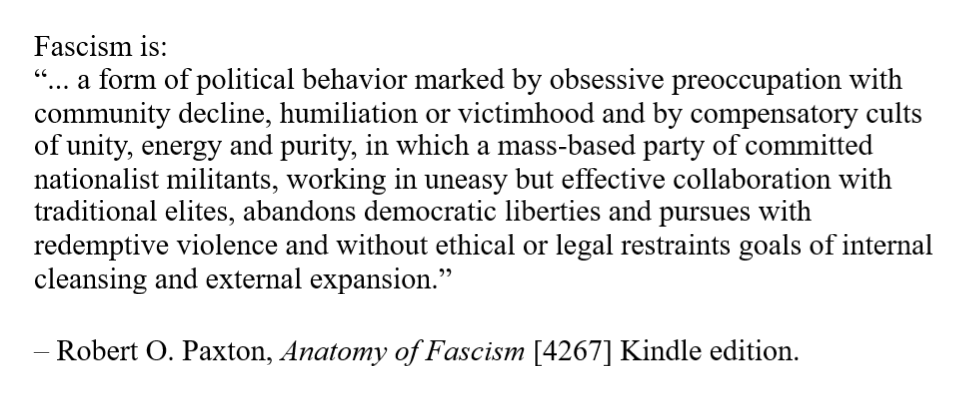
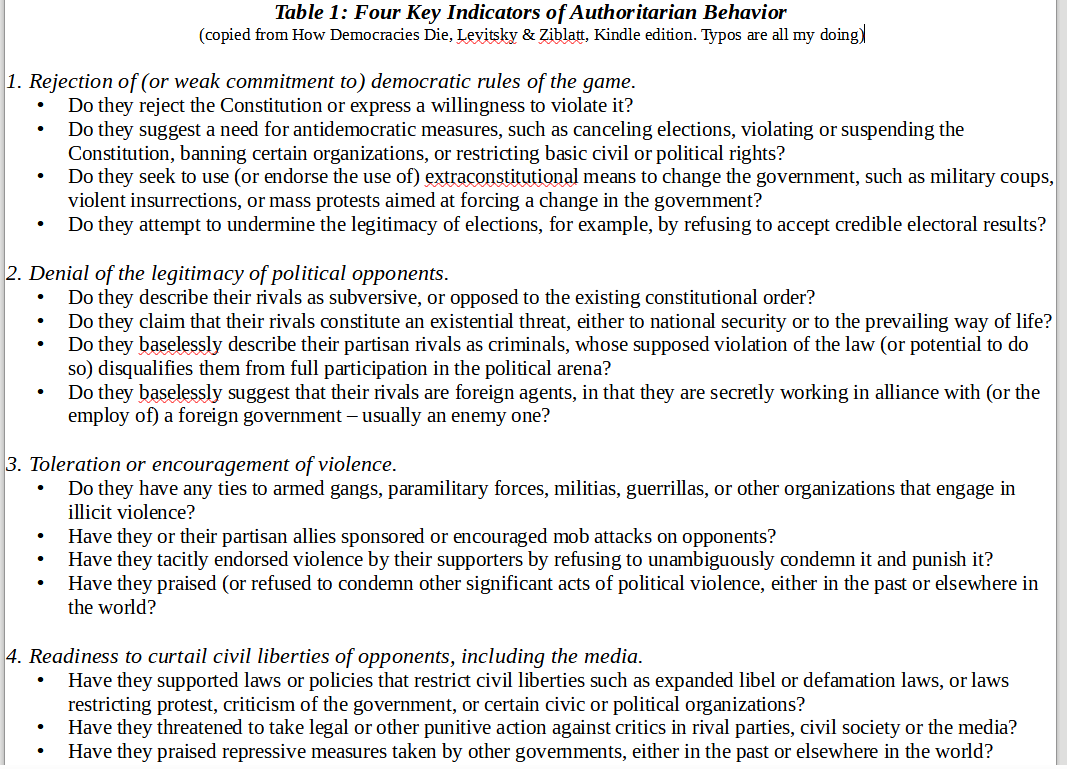
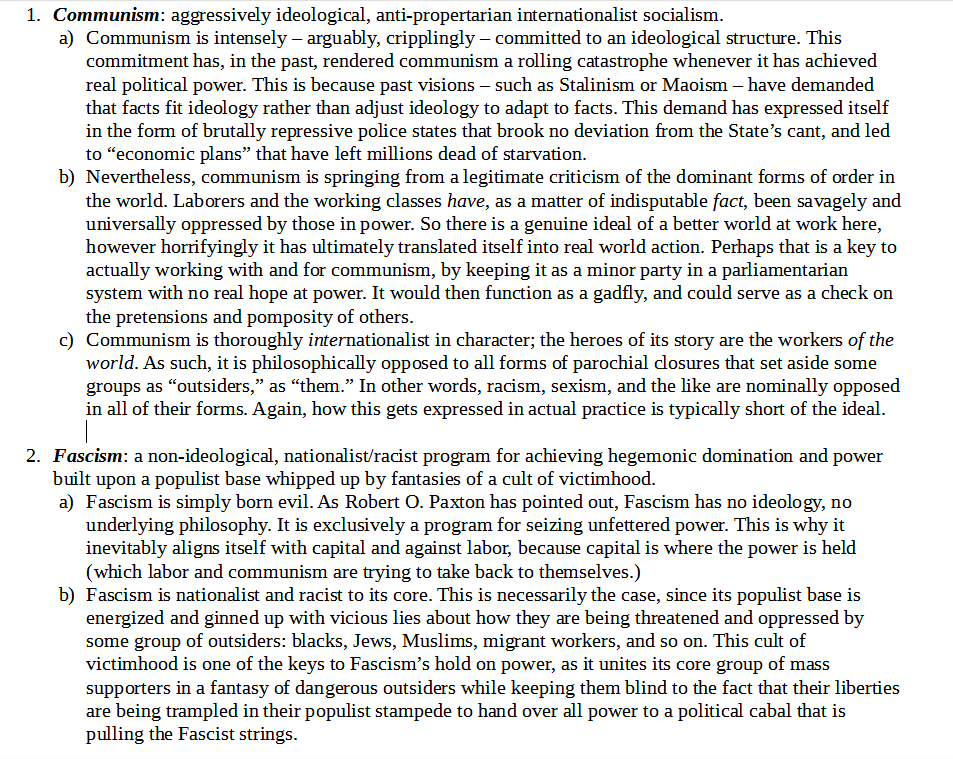
A recent interaction on social media reminded me of the widespread – and commonly enough, absolutely willful – ignorance of basic political distinctions that are rampant among so many people in the U.S. In particular, I was rather aggressively informed by an individual whose education ended somewhere in the 4th grade (regardless of how much time they actually spent in school) that communism and fascism were identical. Now, one need not be an especially enlightened thinker to recognize what galactically infantile nonsense on stilts such a clownish identification obviously is, but I thought I would use the moment to challenge myself to generate shoestring characterizations of both that, while undoubtedly insufficient by an expert’s criteria, might still serve as a useful thumbnail sketch for those of us who are not experts.

First, let me state what is implicit in the above: I am not an expert. Social/political philosophy is not any of my areas of scholarly expertise. However, I do have a Ph.D. in philosophy, so I am at once a fairly educated and articulate human being, and I’ve had a better than average exposure to such ideas. So scratching out such rough and ready comparative characterizations is nominally well within my reach. The trick that makes it entertaining for me (and possibly useful for others) is creating such formulations in a short and handy way that provides an adequate indication of each position.

Second, a word of caution: as Aristotle pointed out over 2300 years ago, requiring scientific precision of non-scientific topics is manifestly foolish. The shorter form of this caveat can be summarized as, “definitions are dumb.” Unless you are working in one of the mathematical disciplines (in which group I also include such things as computer programming, theoretical physics, formal logic, and such) then anything presented as a definition is never more than a guiding heuristic, not a rigidly absolute rule. Many people seem not to understand this (or deliberately ignore it in the hope of scoring “points), especially when dealing with matters of politics. Hence, any person demanding rigorous definition of, say, either communism or fascism is either guilty of ignorance, disingenuousness, or both. Hence my insistence that what follows are “guidelines,” “characterizations,” “sketches,” and the like. So let us begin.