• About me (Gary L. Herstein, Ph.D.) / Contact form
  • Furious Vexation (general questions here)
  • Statement of Intent
  • With regard to Comments and Spam

THE QUANTUM of EXPLANATION

~ Science, logic, and ethics, from a Whiteheadian Pragmatist perspective (go figure)

THE QUANTUM of EXPLANATION

Category Archives: Ethics

Precept, Contract, and Relation

10 Tuesday Sep 2024

Posted by Gary Herstein in Ethics, Objective Morality, Process Philosophy, Relationalism

≈ 1 Comment

Tags

Ethics, History, Morality, Philosophy, Process Philosophy, Relational thinking

An article by Yonaton Zunger from seven years ago received some new legs on social media, enough that I was made aware of his argument.1 Zunger’s basic argument is that what seems like a moral “precept” of, say, tolerance, is in reality a social contract. This is why when individuals break that contract – for example, neo-fascists like Trump and his cultists – we are no longer under any obligation to show such people the tolerance which they categorically refuse to show to others. It is a good essay and worth reading.2 And it did what such essays are supposed to do: it got me thinking. So I am going to do my own spin on this idea, but from a Whiteheadian and Process orientation.

The basic claim in Zunger’s article is that “tolerance” is not so much a moral ideal as it is a social contract. As a moral ideal, it saddles us with the “paradox of tolerance,” where we must either be tolerant of the intolerant who will not hesitate to obliterate us, or else we must violate our moral ideal and be intolerant in response. There have been various responses to this so-called paradox, but most of them have stayed within the bounds of treating tolerance as a moral precept. Zunger’s move is that he denies the status of the idea of tolerance as a moral precept entirely, arguing instead that it is a social contract.

The idea of a social contract goes back at least as far as Thomas Hobbes (1588–1679), though arguably its best early formulation can be found in the work of John Locke (1632–1704); it’s most famous contemporary advocate would surely be John Rawls (1921–2002). The basic idea of the social contract is simple enough: members of a society enter into a kind of contract with one another in which they agree to certain rights and responsibilities with respect to one another. Insofar, it is really indistinguishable from a standard business contract, the idea of which most of us are at least marginally familiar with.3 The difference here is that there is no actual contract in law.4 Rather, there are patterns of behavior and expectations that can be represented as exhibiting contract-like agreements of mutuality between members of a social group. The term “mutuality” is going to come front and center in a moment, hence I highlight it now. So the social contract theorists provide a metaphor and an example of how social interaction ought best to function in the ideal, based upon this concept of a contract binding each to all.

In contrast, a moral precept is often taken to be a kind of “absolute,” although even here there is a dangerous superficiality and dogmatism in the suggestion. Arguably, such precepts should be viewed as guiding ideals, heuristics in the exercise of moral inquiry, and not as rigid and non-negotiable demands. It is this latter approach that creates the so-called paradox of tolerance, where tolerance is treated as just such a moral absolute, rendering it impotent to defend itself against the savage onslaughts of the willfully intolerant. Zunger’s argument is that tolerance is not a moral precept of any kind: rather it is a social contract, an agreement implicit in its formulation but binding in its application. Thus there is no “paradox of tolerance” for the simple reason that no paradox is involved in showing no contractual obligations to someone who has already willfully destroyed the very basis of that contract.

Pages: 1 2

Relational Ethics

01 Monday Jun 2020

Posted by Gary Herstein in Ethics, Inquiry, Personhood, Relationalism

≈ Leave a comment

Tags

Ethics, Personhood, Relational thinking

Time to take a break from my meditations on the year of the plague; life still goes on.

Ethics, especially as caricatured by philosophers who have written on the subject, has (the story goes) often been taught as a collection of rules “informing” the student about what the youth (invariably male, as was the instructor, up until the late 19th, early 20th centuries) should or should not do. In this picture of things, ethics (theory, if you will) was simply the ironclad apologia for the morality (practical, cultural practices) of the day. As noted, this is at least somewhat of a caricature, and if one turns instead to the pages of the great philosophers – specifically Aristotle, Kant, and John Stewart Milli, representing virtue, deontological, and utilitarian ethics, respectively – one can recognize that even as these thinkers morality remained rooted in the assumptions of their day, their ethics as written placed the emphasis not on lists of rules but forms of practical inquiry. This point was given explicit pride of place by John Dewey in the excellent part 2 of the Dewey & Tufts Ethics (the part where Dewey was the sole author), “Theory of the Moral Life.”

But while emphasizing the inquiriential aspect of ethical theory, another aspect of the subject matter – implicit in treating ethical theory as a mode of inquiry – deserves discussion. A simple prescription of static rules would actually suffice were it not for two things: ethics itself is not static, and the nature of that dynamism means that ethics is fundamentally relational in character. I’ll focus exclusively on the latter point here.

Pages: 1 2

Mothers of the Disappeared

20 Wednesday Jun 2018

Posted by Gary Herstein in Ethics, Fascism, Moral Law

≈ 5 Comments

Tags

Ethics, moral laws, Morality

Anyone defending Trump’s concentration camps on the ground that “there aren’t gas chambers”, has only convicted themselves of absolute moral bankruptcy. These same people will still be justifying these concentration camps when there ARE gas chambers.


Children Auschwitz

Trump’s recent EO is irrelevant to the above, which was true long before that EO was ever signed. Such persons have shown their true colors. And that EO only nominally stops the further sepAration (note the spelling, which Trump managed to fuck up); it does nothing to address those who have already been herded into the camps, many of whom have long since been entirely lost in the system.

My Boner, My Self

30 Wednesday May 2018

Posted by Gary Herstein in Ethics, Media, Personhood, Power, Psychology, Violence

≈ Leave a comment

Tags

Jordan Peterson, Male Entitlement

Ho-hum, another school massacre. But this one shares some connections with our neighbors to the north that merit exploration. One part of those connections introduced the general population to the term “incel”, for “involuntarily celibate.” On the surface, the term means just exactly what it says – one is presently non-sexual in one’s life, while wishing there was (in fact) someone there as a physical partner. This nominally suggests that one is single, but that is not a necessary condition; a person can be in a committed relationship in which the other partner, while present as a person, is not available sexually. (When such a situation is unilaterally imposed, it generally signals the end of the relationship, though bonds of loyalty and commitment will, among decent people, still take a while to break down.) Most people have, I am sure, spent significant amounts of time single and celibate when they’d much rather have been busily involved with one (or more!) other partners. But the notion of “incel” goes far, far, beyond this: it implies a profound injustice imposed from without, and (more importantly) a manifest entitlement to the sexual favors one is not receiving. Hence, “My Boner, My Selfi”HaHa

Needless to say, such a collection of beliefs is almost exclusively limited to males. (One can hardly describe such self-absorbed snivelers as “men.”) Thus, both of the above mass murderers were motivated NOT by bullying, but by sexual frustration under the perceived rubric of male sexual entitlement. Dimitrios Pagourtzis stalked and harassed a girl for months before she finally had enough of his unwanted advances and publicly embarrassed him to get him to stop. Her reward for standing up for her own rights and the sanctity of her own person was to be the first victim Pagourtzis murdered. Alek Minassian explicitly identified himself and his murders with the incel “movement.” Both of these sociopaths believed themselves to deserve the sexual favors which they saw the world as unfairly denying to them, and believed that their murderous rampages were a mighty blow in the name of justice. In reality, of course, there are scarcely words in this or any other language capable of heaping upon these worthless excuses the measure of disdain, vituperation, disgust, and contempt that they genuinely deserve. Yet despite these obvious and indisputable facts, there are those who pose as “intellectuals” who variously present (whether explicitly or implicitly) Pagourtzis and Minassian as victims. Rather than say more about the incel infantilism, I want to address the movement’s enablers and apologists and, along the way say a bit about real men and real scholars. The emphasis on men is, again, because males are the overwhelming perpetrators of these crimes, as well as of the public mewling about their poor, neglected wee-wees. But before making any generalizations about “men,” as a collective plurality, let’s contextualize the discussion by establishing some poles between which we might hope to develop a spectrum. For one such pole, let’s start with Jordan Peterson.
Continue reading →

The Accretion of Value

27 Monday Feb 2017

Posted by Gary Herstein in Ethics, Process Philosophy, Relationalism, Whitehead

≈ 3 Comments

Tags

Ethics, Metaphysics, Process Philosophy, Whitehead

[Update below]

Whitehead’s philosophical work is not often viewed with an eye toward its contributions to ethical or political theory. David Hall’s work stands out as one of the better known exceptions to this rule, and Jude Jones’ study of Intensity in Whitehead’s thought has immediate applications in the area of ethics, though it is often viewed from a purely metaphysical angle. I thought it high time to bring a little Whitehead back into this nominally Whiteheadian blog, and current events have offered some examples of how this might be done. Obviously this won’t be anything even remotely approaching those mentioned works’ level of scholarship; indeed, I wish to say up front that anything I say here is simply a product of my own musing, and not to be attributed to anything Hall or Jones said (although, at this point, I can scarcely tell how much is my own thought, and how much I’ve just internalized from others’ work that it is now a part of my own fabric.) No small part of the problem is that, by the time you’ve explained Whitehead, you’ve no space or energy left to apply him to ethics. This is why this post will be some 200+ words longer than I otherwise aim for.magnetic-field

One thing that can be usefully set out right up front: Whitehead’s entire professional career, whether mathematical or philosophical, was dominated by two generic problems that can be usefully described as “the problem of space” and “the problem of the accretion of value.” This issues often overlapped for Whitehead. Thus, in his earliest major professional work, his Treatise on Universal Algebra (a mathematical work on logical forms of space), he devotes several paragraphs to the importance of good symbolism for efficient and unambiguous expression and use of concepts. This is a matter directly relevant to the accretion of value, because good symbolism is a value that accumulates with each gain in efficiency and clarity. In his works on education (widely acknowledged to by sympathetic with Dewey‘s) Whitehead uses ideas of mathematics pedagogy to advance claims about the nature and purpose of a liberal education, education being one of the primary means for the accretion of value. These examples by themselves are almost enough to (loosely) ground the case for a Whiteheadian ethics. But I want to add a few details and then (as mentioned) give a brief application. Details of my discussion can be found HERE. Continue reading →

The Reverend Doctor Martin Luther King

18 Monday Jan 2016

Posted by Gary Herstein in Ethics, Ferguson, Martin Luther King, Moral Law

≈ 5 Comments

Tags

Ethics, Martin Luther King, moral laws, objective morality

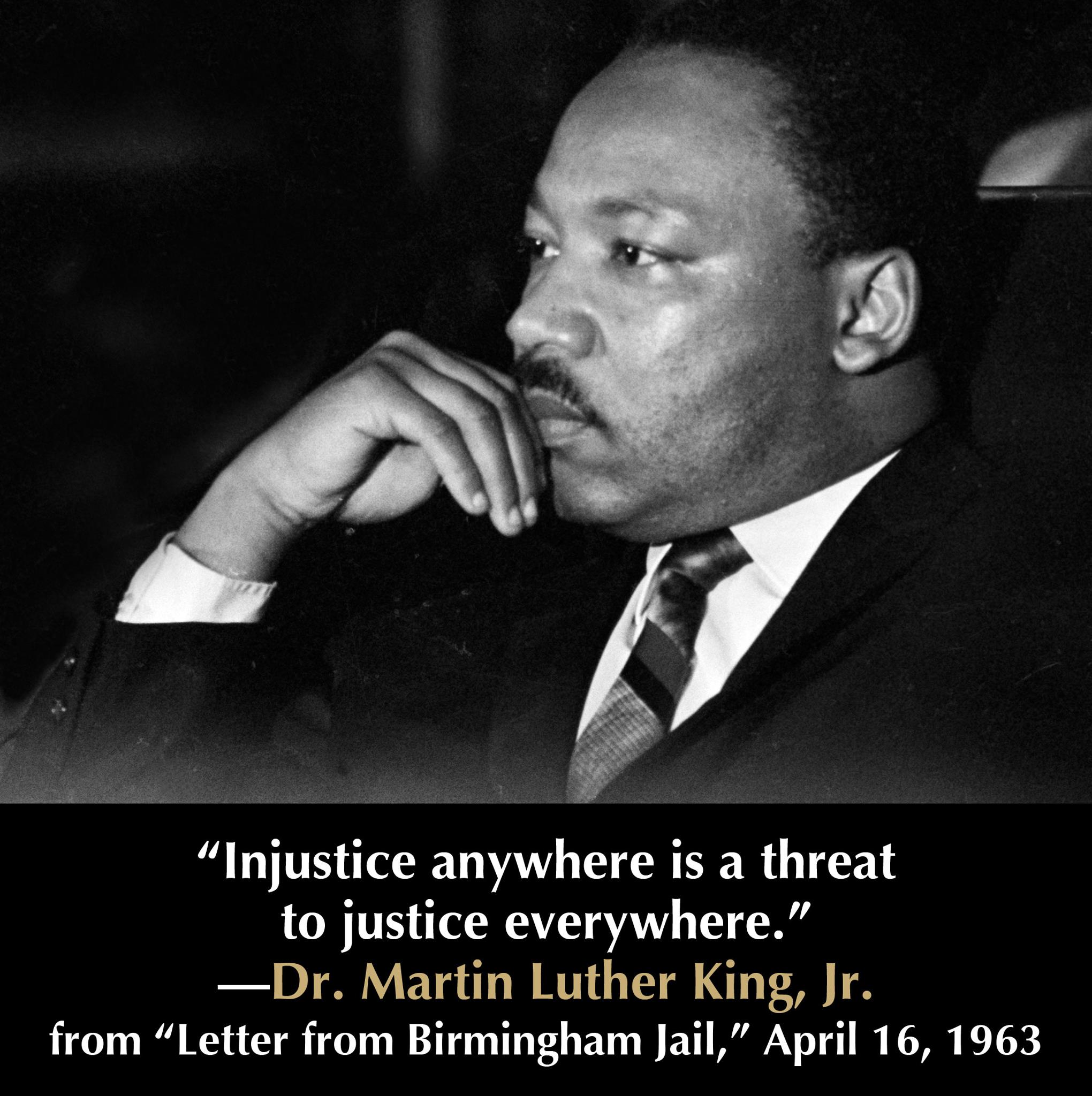
I missed Dr. King’s actual birthday, because I’ve the organizational skills of an F3 tornado and the discipline of a goldfish. But at least I’ve something for the official Martin Luther King day.King Injustice Anywhere

While the Reverend Doctor King had a Ph.D. from Boston University in Speculative Theology, he was also (of course) a Baptist Minister. I’ll have some thoughts to share about right-wing reactions to this fact below the fold, but now I wish to point out some facts that make some atheists on the left side of the political spectrum a bit uncomfortable. First among these, not only was King a Baptist minister, but the entire American Civil Rights movement was religious to its core. A number of the noisier atheists seem to think that, after watching five minutes of Pat Robertson, they are now experts in theology and the history of religion. This presumption often leads these folks to conflate right-wing ideologues spewing twaddle clothed in a veneer of religious talk with the entire spectrum of human religious experience, and utterly oblivious to theological (to say nothing of philosophical) ideas about “god.” (See for example HERE and HERE.) But more importantly for our purposes, there is oftentimes a systematic failure amongst some secularists and atheists to understand that the American Civil Rights movement was irreducibly religious in character, in organization, and in philosophy. Secularists participated in the movement, but they played no substantive role. So these types of atheists contradict themselves when they simultaneously praise the civil rights movement and yet damn all religion wholesale. Continue reading →

Thieves, Dirty Thieves, and Plagiarists

23 Monday Nov 2015

Posted by Gary Herstein in Ethics, Objective Morality

≈ 6 Comments

Tags

Ethics, Plagiarism

A colleague of mine asked if I might do a post on plagiarism. For the record, I do requests (try the veal and be sure to tip your waitress; or is it the other way around?) I will resist the temptation to stampede off into rhetorical excesses about “special circles of hell,” but I am offended by plagiarism to the core of my being. Plagiarism is the cardinal sin of scholarship only to the extent that cardinal sins are warm and fuzzy things that you laugh about at a party. OK, some rhetorical excess …cockroach5

Plagiarism is nominally the stealing of words and concepts, and then presenting these as your own original work at the time of presentation. This definition is not the one you’ll necessarily find in the dictionary, because those definitions tend to emphasize the stealing of other people’s words, while I mean to insist that there is also such a thing as self plagiarism. (Also, dictionary definitions and Wikipedia entries do not answer questions so much as they provide a useful heuristic for asking better questions.) Most persons who deal with and condemn plagiarism do so as a charge against the plagiarizers for not doing the work they claim to have done. I will go much further than this charge, however, and argue that the plagiarizer has not simply stolen materials, but has positively wounded the person stolen from. Continue reading →

The Least of These

19 Thursday Nov 2015

Posted by Gary Herstein in atheism, Ethics, God, Logic, Syria

≈ 4 Comments

Tags

Authoritarians, Ethics, God

I am not a religious person, a fact I’ve never hidden from anyone. However, I’ve also made it clear that I am impatient with “lazy atheism” – cheap shot forms of willful ignorance that make no effort to grasp the differences between religious, theological, and philosophical concepts of “god,” or the many nuanced ways in which such a being might creatively interact with the world. Just because you watched five minutes of Pat Robertson on the television does not mean you are an expert on the subject – not even on the subjects of religions as these are practiced, in fact, by people, much less the full range of concepts, both actual and possible, relating to “god.”

syrian-refugee_1

But if lazy atheists are tedious, lazy theists are downright disgusting. I’ve never invested the effort to actually study the Bible, but I did read large portions of it when I was a child. So when my knowledge of this collection of texts exceeds that of persons who publicly posture themselves as devout Christians, I am disinclined to treat such people charitably.

It is my unscientific impression that these persons – willfully ignorant yet declared devout Christians – are invariably conservatives of an extreme variety.

The liberal Christians I have met (and, again, this is not a representative sample) have not only been less inclined to make public displays of their religious beliefs, they have been much more interested in learning and discovering new and different aspects of religious beliefs in others. The difference here may well be due to the fact that conservatives are much more inclined toward adopting authoritarian mind frames, to the extent that not only are they less interested in learning new things, but they are often positively opposed to permitting others to do so.

So it is that I cannot tell if it is ironic, or merely pathetic, that the noisiest opposition to the admission of a handful of Syrian refugees (a “handful” in comparison to the staggering numbers of them) to the United States, seems universally to be coming from conservative “Christians.”

44″Then they themselves also will answer, ‘Lord, when did we see You hungry, or thirsty, or a stranger, or naked, or sick, or in prison, and did not take care of You?’ 45″Then He will answer them, ‘Truly I say to you, to the extent that you did not do it to one of the least of these, you did not do it to Me.’

Mathew 25: 44 – 45

When We do “IT,” It’s ok …

01 Sunday Nov 2015

Posted by Gary Herstein in Anonymous, Critical Thinking, Ethics, Objective Morality

≈ 9 Comments

Tags

Anonymous, Critical Thinking, Ethics, moral laws

So, I just read how the hacker “group” Anonymous has been publicly outing members of the KKK. This has been variously accompanied by triumphalist celebrations by some people on the political Left. “Yay … justice … woo-hoo …”

I find such behavior singularly disgusting, both the outing and the celebration of it. When homosexuals are outed against their will – sometimes with devastating consequences – this is an intolerable violation of those persons’ privacy and lives. But when “we” do something similar, it is “justice”! When workers and protectors at a Planned Parenthood clinic have their faces, their families, their home addresses plastered all over the internet, this is a violent attack on their persons and safety. But when “we” do it, it is “justice”. Because, “obviously,” “we” are “good” guys, and “they” are “bad” people.Mlk-in-birmingham-jail

How is it that the question of right or wrong is exhausted by answering whether or not we are the one’s doing it? The question is obviously rhetorical, and the answer is, “obviously, it is not.”

There are numerous examples of nominally wrong actions being done for right reasons such that those reasons suffice to (arguably, at least) justify those actions. To kill another person is wrong, but if that killing occurred in the course of self-defense or the protection of innocent people, it will generally be viewed as a justifiable homicide. Violating the law is typically viewed as wrong, but when the law itself is unjust and immoral, then violating that law can itself become a moral duty. This is the leverage I wish to apply to the actions of Anonymous toward the KKK. My instrument of choice here is one of the most tightly reasoned moral arguments of the last century: Dr. King’s Letter from a Birmingham Jail. Continue reading →

The Prayer Of A Freeman

24 Thursday Sep 2015

Posted by Gary Herstein in Altruism, Ayn Rand, Ethics, John Dewey

≈ 3 Comments

Tags

Altruism, Ayn Rand, Ethics, John Dewey

The Guardian had an article recently about an emerging movement that some are calling “extreme altruism.” Believers in extreme altruism hew to the conclusion that one is morally obligated to give away a very large part of one’s own resources (“earnings” is a term used in the article, but that is a concept particular to a very specific type of economic structure) in an effort to seriously improve the welfare of others. The author gives the example of “Julia”: “Julia believed that because each person was equally valuable, she was not entitled to care more for herself than for anyone else; she believed that she was therefore obliged to spend much of her life working for the benefit of others.” Julia did not just throw her money at random charities; rather she researched groups that appeared to do the most good, spent their funds most efficiently, and used local people rather than their own, foreign aid workers. (It was because of this last that Julia chose not to become such a worker herself for an NGO – locals would know their own needs of their own peoples, as well as understand the cultural settings of those needs, much better than foreign aid workers.)fishing-03

A personal aside is necessary here. An aside that requires a brief visit to that toilet of non-intellectual sociopathic spew that is known as “Ayn Rand.” Continue reading →

← Older posts
Follow THE QUANTUM of EXPLANATION on WordPress.com

Enter your email address to follow this blog and receive notifications of new posts by email.

Blogs I Follow

  • The Shanarchist Cookbook
  • Cote du Golfe School of Fencing
  • Professor Watchlist redux
  • Free Range Philosophers
  • thenonsequitur.com
  • Blog Candy by Author Stacey Keith
Whitehead, Alfred North

Copyright Announcement

© Dr. Gary L. Herstein and garyherstein.com, 2014 -- 2024. Unauthorized use and/or duplication of this material without express and written permission from this site’s author and/or owner is strictly prohibited. Excerpts and links may be used, provided that full and clear credit is given to Dr. Gary L. Herstein and garyherstein.com with appropriate and specific direction to the original content. (In other words, share but acknowledge.)

Go back

Your message has been sent

Warning
Warning
Warning
Warning

“But in the real world it is more important that a proposition be interesting than that it be true. The importance of truth is, that it adds to interest.” – Alfred North Whitehead, Process and Reality

Archives

Spam Blocked

70,611 spam blocked by Akismet

Blog at WordPress.com.

The Shanarchist Cookbook

Cooking up food for thought & Shanarchy. I am a Philosopher, writer, meditation & mindfulness teacher, & artist.

Cote du Golfe School of Fencing

Fencing / Sword Classes & Lessons Naples, Bonita, Estero, Florida

Professor Watchlist redux

Free Range Philosophers

Loving Wisdom Beyond the Academy

thenonsequitur.com

Blog Candy by Author Stacey Keith

Science, logic, and ethics, from a Whiteheadian Pragmatist perspective (go figure)

  • Subscribe Subscribed
    • THE QUANTUM of EXPLANATION
    • Join 123 other subscribers
    • Already have a WordPress.com account? Log in now.
    • THE QUANTUM of EXPLANATION
    • Subscribe Subscribed
    • Sign up
    • Log in
    • Report this content
    • View site in Reader
    • Manage subscriptions
    • Collapse this bar
 

Loading Comments...