An article by Yonaton Zunger from seven years ago received some new legs on social media, enough that I was made aware of his argument.1 Zunger’s basic argument is that what seems like a moral “precept” of, say, tolerance, is in reality a social contract. This is why when individuals break that contract – for example, neo-fascists like Trump and his cultists – we are no longer under any obligation to show such people the tolerance which they categorically refuse to show to others. It is a good essay and worth reading.2 And it did what such essays are supposed to do: it got me thinking. So I am going to do my own spin on this idea, but from a Whiteheadian and Process orientation.
The basic claim in Zunger’s article is that “tolerance” is not so much a moral ideal as it is a social contract. As a moral ideal, it saddles us with the “paradox of tolerance,” where we must either be tolerant of the intolerant who will not hesitate to obliterate us, or else we must violate our moral ideal and be intolerant in response. There have been various responses to this so-called paradox, but most of them have stayed within the bounds of treating tolerance as a moral precept. Zunger’s move is that he denies the status of the idea of tolerance as a moral precept entirely, arguing instead that it is a social contract.
The idea of a social contract goes back at least as far as Thomas Hobbes (1588–1679), though arguably its best early formulation can be found in the work of John Locke (1632–1704); it’s most famous contemporary advocate would surely be John Rawls (1921–2002). The basic idea of the social contract is simple enough: members of a society enter into a kind of contract with one another in which they agree to certain rights and responsibilities with respect to one another. Insofar, it is really indistinguishable from a standard business contract, the idea of which most of us are at least marginally familiar with.3 The difference here is that there is no actual contract in law.4 Rather, there are patterns of behavior and expectations that can be represented as exhibiting contract-like agreements of mutuality between members of a social group. The term “mutuality” is going to come front and center in a moment, hence I highlight it now. So the social contract theorists provide a metaphor and an example of how social interaction ought best to function in the ideal, based upon this concept of a contract binding each to all.
In contrast, a moral precept is often taken to be a kind of “absolute,” although even here there is a dangerous superficiality and dogmatism in the suggestion. Arguably, such precepts should be viewed as guiding ideals, heuristics in the exercise of moral inquiry, and not as rigid and non-negotiable demands. It is this latter approach that creates the so-called paradox of tolerance, where tolerance is treated as just such a moral absolute, rendering it impotent to defend itself against the savage onslaughts of the willfully intolerant. Zunger’s argument is that tolerance is not a moral precept of any kind: rather it is a social contract, an agreement implicit in its formulation but binding in its application. Thus there is no “paradox of tolerance” for the simple reason that no paradox is involved in showing no contractual obligations to someone who has already willfully destroyed the very basis of that contract.
There is a philosophical position known as “panpsychism.” While it is not an overwhelmingly popular position, it has been getting some attention of late. And as Whitehead himself is frequently characterized as a panpsychist, it seems worthwhile to cast an eye on this notion and say something about it. And of course, the first thing one should say should be an answer to Gollum’s question (“What is it, Precious?”)
The basic idea of panpsychism is that mental activity (the “psych” in “psychism”) is everywhere (the “pan” part. And by everywhere, it is meant to be at all levels of reality, large or small. Mental activity is, in this view, a fundamental element of all that is real, an ontological “primitive” (if you will) that is not constructed from other elements but rather is itself something that is always already “there.” The advantage of this notion is that it goes a long way to resolving the “mind/body” problem by basically arguing that there was never a real problem, only a problematic and erroneous characterization of the real.
I am rereading rereading Robert Goldblatt’s book, Topoi, though in many respects it seems like I’m reading it for the first time. When there is enough time and space between myself and some volume or other, that experience of ‘(re)reading it for the first time’ is not all that uncommon. It occurred not too long ago with E.P. Thompson’s The Making of The English Working Class, and Durrell’s Alexandria Quartet. Those works both had in the neighborhood of forty years between the first and the second readings, so I feel less guilty at the sense of surprise and pleasure. With Topoi, my excuses are somewhat more thin, though I can still assert with considerable truth and honesty that there’s been considerable intellectual development on my part since the first time I tackled the book. I mention this not just to make what amounts to little more than a peculiar Facebook post (some people share pictures of their meal, after all), but to set up a discussion of why a Whiteheadian should pay special attention to that area of abstract algebraic thinking known as Category Theory. I’ll first spend a few words talking about the book itself.
The word “topoi” is the plural form of “topos,” which seems rather more elegant than saying “toposes.” A topos is a category theoretic structure that is rich in a variety of “nice” formal characteristics, the details of which I’ll spare you (as that would require an entire book on category theory to explain.) Now, a category (such as might take on the structural features that would further specify it to be a topos) is a mathematical constructions that turns away from “objects” so-called to devote particular attention to functions, transformations, and operations without any special concern for the supposed “what” that is being transformed or operated on. As such, category theory is arguably the purest form of algebraic thinking around. It is scarcely an accident that Leo Corry’s magnificent history of the development of abstract algebra, Modern Algebra and the Rise of Mathematical Structures, ends with the emergence of category theory.
There is a certain group of scholars – I’ll name no names – which has taken on such a dominant position in Whitehead scholarship (at least, within the US), that one could arguably characterize their position as “hegemonic.” I have personally met a number of individuals associated with this group, whom I’ll simply call “The Group,” and freely admit that they are, as individuals, fine, generous, and altogether excellent folks. My complaint here – and I will be complaining rather sharply – is not with any of them as particular persons, but rather with the hegemonic direction in which The Group has taken Whitehead scholarship. That direction is what I am calling “Happy-Fluffy-Touchy-Feely-God-Talk” (HFTFGT from now on.)
Now, there is no question that Whitehead spoke of “God” extensively in his writings. Many people have the devil’s own time with such talk, those whom I’ll often characterize as “Ouchie Atheists,” for whom any such discussion drives them either into a fury or else into something like a cognitive anaphylactic shock. (Sometimes both.) This is one of the lesser pities of our day and age, a consequence of neo-fascist Christian Dominionist fundamentalists having hijacked the word and all discussions thereof. It is additionally unfortunate with regard to Whitehead scholarship because his use of the “G-word” could easily be replaced throughout his text with the Greek word “arché,” which would eliminate at a stroke the difficulties the Ouchie Atheists have and (arguably, at least) make it possible for them to dive more deeply into Whitehead’s texts and arguments. But Whitehead was intransigent in his refusal to employ non-English words. “Atom” was an exception. Though it originated with the Greeks, it had by his time – both by convention and courtesy – been thoroughly adopted as “English.” This is a little ironic, since contrary to most physicists of his day, Whitehead continued to use it in the original Greek sense of “a-tomos,” meaning “uncut.” So an atom for Whitehead was not a microscopic corpuscle, but an undivided whole which could be of any size.
I like the word “arché” because it can be translated as “foundation/font,” and this is what Whitehead meant by “God”: the rational foundation of reality, and the font of creativity. (This latter is one of the things that distinguishes process philosophies from static, substance based ones: the universe is a process of creative advance.) Notice that I do not suggest the Greek word for “god,” “theos” (or possibly “theou,” my Greek is not very good.) This is a deliberate choice, readily justifiable by even a moderately close reading of what Whitehead actually says, particularly within the pages of his masterwork of metaphysics, Process and Reality (PR).
With, however, the exception of one sentence.
This sentence appears in the last few pages of PR, which are separated from the rest of the volume as Part V. The language and argument of this final, very short “part” is fundamentally different from the preceding hundreds-plus pages of text, and this radical difference has led some to wonder just how genuinely integral an element of the rest of the discussion it truly is. In these final, very few pages, Whitehead allows himself to slip into more poetic language, most particularly with the above mentioned one sentence – which I’ll not quote. (If you know, you know, and if you don’t you’ll recognize it instantly should you ever read PR to the end.) But members of The Group, and others sympathetic to their program, latched onto that one sentence and ran with it. They ran fast, long, and hard, and are still running. From this we get the HFTFGT of process theology.
And it has swallowed the scholarship whole. So much so that Whitehead’s triptych of 1919 – 1922 (Enquiry into The Principles of Natural Knowledge, The Concept of Nature, and The Principle of Relativity with Applications), a revolutionary re-evaluation of the entire philosophy of nature, have largely vanished from the canon of Whitehead’s works that are studied. (Let me reiterate that this is within the US. Chinese scholars, for example, recently celebrated the centennial of those works with no fewer than three separate conferences, one for each book.)
Even those works of Whitehead’s that do receive some attention receive it only selectively. Thus part IV of PR, for example, is often skipped over and ignored with students sometimes being told to ignore it because it is “irrelevant.” One might, alternatively, point out that part IV is the beating heart of Whitehead’s entire relational system, where he presents his mature mereotopology, his non-metrical theory of curvature (“flat loci”), his subtle theory of physical connectedness and causality (“strains”), his completed theory on the internalization of relatedness as the flipside to the theory of the externalization of relatedness found in part III, etc. But part IV also involves a lot of logical and mathematical thinking “stuff,” and so one can just skip over that because it doesn’t feed into HFTFGT. A more cautious reader might suspect that what this rather demonstrates is that it is HFTFGT that is flopping around looking for relevance. But such cautious readers are not being invited into the club, and their professors are not encouraging their students to adopt such cautious approaches.
It is partly as a result of this narrow and eminently disputable presentation of Whitehead’s philosophy that many outside the field who might otherwise profit from engaging with Whitehead’s ideas (especially persons in the sciences), explicitly reject the notion out of hand. Because, after all, Whitehead is “nothing more than” a lot of HFTFGT. And people “just know this to be the case” because they are constantly and loudly reminded of this “fact” by those experts who are only interested in HFTFGT.
(Of course, persons in the physical sciences tend to reject any suggestion of engaging in philosophy because it is, after all, philosophy. They often do this as they explicitly engage in philosophical discourse; and do so badly.)
Such a reductionist caricature of Whitehead’s thought is, of course, the worst sort grotesquely fatuous twaddle imaginable. Let me repeat, Whitehead wholly re-imagines Nature in a relationally robust and holistic framework that is original, insightful, and logically rigorous. But consider in comparison what your grasp of Christianity might be were it the case that all you ever heard about it came from the neo-fascist Christian Dominionist fundamentalists. Your idea of Christ would look more like Adolf Hitler. (By the bye, in contrast to the neo-fascists, the advocates of HFTFGT promote a vastly more Christ-inspired vision of God and the gospels that is genuinely loving and caring for ALL of creation.) And so it becomes increasingly difficult to even suggest to people who are not already heavily, even exclusively, invested in HFTFGT to cast even a casual eye on Whitehead’s work.
Which brings us to the matter of how a vine can kill a tree.
There is a method of killing a tree called “girdling.” A tree grows out as well as up. But if something is tightly bound around the outside of the trunk (it is “girdled”) the tree can no longer grow outwards. And it is these outer portions that carry the nutrients up the trunk to the rest of the tree. So the effect is like a garrote.
A vine is capable of girdling a tree. There is no malevolence involved, no ill or predatory intent; but the effect is the same. This is what ‘The Group’ is doing, I would argue, to the larger tree of Whitehead scholarship. (One of the ironies here is that they themselves are being girdled by the neo-fascist Christian Dominionist fundamentalists, who deny that liberal – never mind process – theology even qualifies as Christianity, or as anything other than the work of the Devil, even though this form of “devilry” is demonstrably truer to the Gospels. But just try to find someone who is not already an expert in the field who is even aware of the existence of process theology.)
I don’t want the HFTHGT people to go away, but I would like to see a serious effort on their part to acknowledge that their project emerges from a vanishingly small corner of Whitehead’s work. I don’t want to chop down the vine, but I would like the vine to stop strangling the tree. This would include exercising some genuine circumspection about what they attribute to Whitehead, as opposed to what they themselves rather freely speculate about, far beyond anything he – in his meticulous, mathematically rigorous and disciplined way – ever pretended to entertain.
I can’t speak for other cultures, but phrases such as the above and others akin to them are fairly commonplace in American conversation, particularly when the topic involves the foolish choices made when we were young. While often accompanied with an eye roll and a shake of the head in signs of regret, there is just as often a tinge of wistfulness as well, a longing for a return to that kind of vivid recklessness and the electrifying sense of being alive that was at its core.i There is certain legitimacy to that longing – even, and even especially, for the mistakes – at the metaphysical level. For every act of creation is, in an important sense, an error, a mistake, a “failure” to follow the “correct” path. So it is worth a moment to take a look at such things.
Before going any further, I want to dismiss one kind of mistake that is grotesque in its calculated refusal of any possibility of creativity. That is the kind of action “celebrated” by the despicable Jackass films and shows. These aren’t errors of any kind. They are acts of willful stupidity pandering to the lowest element of human character, “entertainment” predicated on laughing derisively at others for pulling absurdist stunts devoid of any talent or art. These programs are simply an extension of the “Good Ol’ Boy’s last words” jokes.ii There is nothing interesting or amusing about such behavior or the people who wallow in it.
Some sixty-one years ago, the American philosopher Willard Van Orman Quine wrote a famous essay, “On Simple Theories of a Complex World.” Actually, referring to this as a “famous essay” is a tad redundant, since Quine is one of those people who only ever wrote famous essays. But setting that observation (bordering on sour grapes) aside, Quine goes on to observe the difficulty in saying just what does qualify as simplicity. He further observes the legitimate psychological and formal reasons while theory builders so ardently crave simple theories: the simpler the theory, the more readily it can be employed in our various cognitive activities. Of course, too simple a theory leaves us with no purchase on the world what-so-ever. “God willed it” is about as simple a theory as you can come up with, but it is also as singularly useless a theory as anyone could ever imagine; it provides absolutely no insight, a complete absence of predictive power, and only an illusion of emotional comfort for those readily distracted by vacuous hand waving.
A “Rube Goldberg” machine.
Quine was writing more than a decade before the emergence of computational complexity as a sub-field of abstract Computer Science, in which upper and lower bounds for kinds of complexity (and thus, conversely, forms of simplicity) was even formulated. But we do now have a variety of ways to address Quine’s concerns about how to characterize complexity and simplicity. I’ll say more about this in a moment. What I want to start with a more controversial proposition: Namely, Quine got it backwards. In a very real sense, it is the world that is fundamentally simple and our theories that are complex.
Some tasks, processes, “computations,” are too difficult to do in any practical context. Some are so intrinsically hard that, even while they don’t seem especially difficult, God herself could not do them. The first is the problem of computational complexity, the other of computability/solvability. The former, complexity, emerged from the latter, computability, because the problem of computability was more obvious to mathematicians who’d never seen, much less actually used, a computer. But after Alan Turing presented his own abstract model of a computing “machine” (the “Turing Machine,” or TM) to prove the existence of unsolvable mathematical problems, the difference between what could be solved in theory (computability) and what could be solved in practice (complexity) came into view, and methods were developed to investigate the latter as well as the former. This is all by way of summary of, and pointing forward from, the previous post.
Mechanical Turing Machine
There are theoretical &/or partial work arounds, ways of tricking out the game, for both complexity and computability. For complexity, it is unclear whether the trick can be realized in practice. For computability, it is unclear whether the trick (which is only a partial trick, really) is even physically possible. Still, I’m going to talk a little about both – in the preceding order – and finish with some comments on how these theoretical considerations can be manifested in our considerations of what does and what does not constitute legitimate scientific inquiry, and a few comments closing the circle on analysis versus ontology.
I have this absurd fantasy that sneaks up on me sometimes in my mellower moments (so, rarely). It is the thought of moving to some place like Key West, or one of the smaller Hawaiian islands. I’d spend my days hanging out at beachfront cabanas sipping rum drinks, noodling away at whatever writing project engaged me at the time. I’d be so familiar to staff that they wouldn’t even trouble to ask me what I was having before bringing my first drink over. I’d never wear socks, or underwear, or shirts with collars ever again. (Actually, I’m already basically there with that latter.) My head will be filled with creative imaginings and ear-worms of Beach Boys songs.
Now, as I’ve already noted, this is an absurd fantasy. Quite aside from the fact that, short of winning one of the larger lottery prizes I’d never be able to afford such locales, there are the facts that I can barely suffer the heat and humidity of Midwest summers, and AGWi driven sea rise means the storm surge from the next big blow to hit these places will sweep away every last trace of human habitation. But fantasies seldom allow logic or facts to interfere with them; just consider those pitiful rubes who voted for Trump (twice!) and even imagine he won the 2020 election. Yet I still buy a lottery ticket every now and then, even though I understand I’ve a better chance of being struck by lightning in any given year. (About 1 chance in 1,220,000.)
But there is something about those places, something that really catches and hold your imagination. For the record, I’ve been to Key Largo and Key West. And while I’ve never been to Hawaii, I have been to Tahiti, which has a very similar climate. There’s just something in the air and the light that is not like other places; something romantic even in the loneliness. And that’s what I want to talk about here, the sense of place.
A running joke that Dr. Auxier and I incorporated into our booki was the phrase, “skip to page 337.” The pagination reference is to the Free Press edition of the corrected version of Whitehead’s monumental work of metaphysics, Process and Reality (“PR” hereafter.) Page 337 of PR is the start of the fifth part of the work, his rather poetic discussion on “God,” beyond the more concrete arguments of the preceding 337 pages. By “concrete” it should be understood that Whitehead’s “God” is not some religion inspiring big daddy in the sky that you go to church to beg candy from. Uneducated rumors to the contrary not withstanding, Whitehead never invented words. But at many points in his tome on “speculative philosophy” (his preferred term for what others call “metaphysics”) he needed to identify an “omega point” which served as the entirely impersonal foundation for the rational structure of the world as well as the “font of creativity.” He called this “God.” Were he inclined to use non-English words, a better choice might have been the Greek “arché” (αρχη). But Whitehead was Whitehead, and that was never going to happen, and so it did not.
Setting aside for the moment the question of “God,” there are some important issues in the material that the people skipping over to pg. 337 are, in fact, skipping over, in their stampeding rush to gin up a “Whiteheadian” theology. There are two things I want to talk about that are left all but untouched in the secondary literature on Whitehead, one of which is interesting and the other is downright revolutionary. These things appear in the pages that many scholars ignore when the skip to pg. 337. They are what Whitehead called “strains” and “flat loci.” I’ll address these in order. But first I’ll devote a paragraph to the work on natural philosophy that Whitehead developed in the years preceding PR.
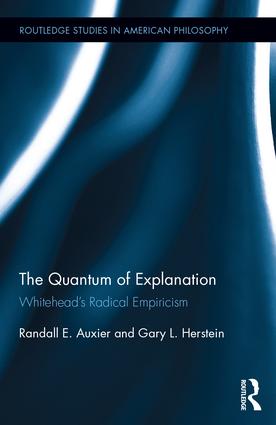
Taylor/Francis (Routledge) is having a sale on electronic versions of the book I coauthored (and which this blog is named after) The Quantum of Explanation: Whitehead’s Radical Empiricism. The note from Routledge reads as follows:
(W)e’re running a monograph sale through June 11th. Readers can now access your book free-of-charge for seven days. At the end of the trial period, they’ll have the opportunity to purchase the eBook for £10/$15.
While I am obviously biased, many people who are not me also think that it is a very good book — indeed, one of the most important contributions to Whitehead scholarship in the last few decades. Many books in the secondary literature get Whitehead wrong; if you read our book, you’ll have some idea just how wrong. But in addition, Quantum will (ideally) provide you with essential insights into Whitehead’s magnum opus, Process and Reality, so that you might see for yourself why this latter book is such a revolution in thinking for the Western tradition. I’m not making any money off of this sale, and the price being asked by Routledge is pretty nearly unbeatable. So I encourage you to check it out!










 THE QUANTUM of EXPLANATION