
• About me (Gary L. Herstein, Ph.D.) / Contact form
  • Furious Vexation (general questions here)
  • Statement of Intent
  • With regard to Comments and Spam

THE QUANTUM of EXPLANATION

~ Science, logic, and ethics, from a Whiteheadian Pragmatist perspective (go figure)

THE QUANTUM of EXPLANATION

Tag Archives: Process Theology

Happy-Fluffy-Touchy-Feely-God-Talk

10 Tuesday Oct 2023

Posted by Gary Herstein in Logic, Mereology, Philosophy of Logic, Process Philosophy, Process Theology, Whitehead

≈ 21 Comments

Tags

Logic, Process Philosophy, Process Theology, Whitehead

Or

How a Vine can Kill a Tree

There is a certain group of scholars – I’ll name no names – which has taken on such a dominant position in Whitehead scholarship (at least, within the US), that one could arguably characterize their position as “hegemonic.” I have personally met a number of individuals associated with this group, whom I’ll simply call “The Group,” and freely admit that they are, as individuals, fine, generous, and altogether excellent folks. My complaint here – and I will be complaining rather sharply – is not with any of them as particular persons, but rather with the hegemonic direction in which The Group has taken Whitehead scholarship. That direction is what I am calling “Happy-Fluffy-Touchy-Feely-God-Talk” (HFTFGT from now on.)

Now, there is no question that Whitehead spoke of “God” extensively in his writings. Many people have the devil’s own time with such talk, those whom I’ll often characterize as “Ouchie Atheists,” for whom any such discussion drives them either into a fury or else into something like a cognitive anaphylactic shock. (Sometimes both.) This is one of the lesser pities of our day and age, a consequence of neo-fascist Christian Dominionist fundamentalists having hijacked the word and all discussions thereof. It is additionally unfortunate with regard to Whitehead scholarship because his use of the “G-word” could easily be replaced throughout his text with the Greek word “arché,” which would eliminate at a stroke the difficulties the Ouchie Atheists have and (arguably, at least) make it possible for them to dive more deeply into Whitehead’s texts and arguments. But Whitehead was intransigent in his refusal to employ non-English words. “Atom” was an exception. Though it originated with the Greeks, it had by his time – both by convention and courtesy – been thoroughly adopted as “English.” This is a little ironic, since contrary to most physicists of his day, Whitehead continued to use it in the original Greek sense of “a-tomos,” meaning “uncut.” So an atom for Whitehead was not a microscopic corpuscle, but an undivided whole which could be of any size.

I like the word “arché” because it can be translated as “foundation/font,” and this is what Whitehead meant by “God”: the rational foundation of reality, and the font of creativity. (This latter is one of the things that distinguishes process philosophies from static, substance based ones: the universe is a process of creative advance.) Notice that I do not suggest the Greek word for “god,” “theos” (or possibly “theou,” my Greek is not very good.) This is a deliberate choice, readily justifiable by even a moderately close reading of what Whitehead actually says, particularly within the pages of his masterwork of metaphysics, Process and Reality (PR).

With, however, the exception of one sentence.

This sentence appears in the last few pages of PR, which are separated from the rest of the volume as Part V. The language and argument of this final, very short “part” is fundamentally different from the preceding hundreds-plus pages of text, and this radical difference has led some to wonder just how genuinely integral an element of the rest of the discussion it truly is. In these final, very few pages, Whitehead allows himself to slip into more poetic language, most particularly with the above mentioned one sentence – which I’ll not quote. (If you know, you know, and if you don’t you’ll recognize it instantly should you ever read PR to the end.) But members of The Group, and others sympathetic to their program, latched onto that one sentence and ran with it. They ran fast, long, and hard, and are still running. From this we get the HFTFGT of process theology.

And it has swallowed the scholarship whole. So much so that Whitehead’s triptych of 1919 – 1922 (Enquiry into The Principles of Natural Knowledge, The Concept of Nature, and The Principle of Relativity with Applications), a revolutionary re-evaluation of the entire philosophy of nature, have largely vanished from the canon of Whitehead’s works that are studied. (Let me reiterate that this is within the US. Chinese scholars, for example, recently celebrated the centennial of those works with no fewer than three separate conferences, one for each book.)

Even those works of Whitehead’s that do receive some attention receive it only selectively. Thus part IV of PR, for example, is often skipped over and ignored with students sometimes being told to ignore it because it is “irrelevant.” One might, alternatively, point out that part IV is the beating heart of Whitehead’s entire relational system, where he presents his mature mereotopology, his non-metrical theory of curvature (“flat loci”), his subtle theory of physical connectedness and causality (“strains”), his completed theory on the internalization of relatedness as the flipside to the theory of the externalization of relatedness found in part III, etc. But part IV also involves a lot of logical and mathematical thinking “stuff,” and so one can just skip over that because it doesn’t feed into HFTFGT. A more cautious reader might suspect that what this rather demonstrates is that it is HFTFGT that is flopping around looking for relevance. But such cautious readers are not being invited into the club, and their professors are not encouraging their students to adopt such cautious approaches.

It is partly as a result of this narrow and eminently disputable presentation of Whitehead’s philosophy that many outside the field who might otherwise profit from engaging with Whitehead’s ideas (especially persons in the sciences), explicitly reject the notion out of hand. Because, after all, Whitehead is “nothing more than” a lot of HFTFGT. And people “just know this to be the case” because they are constantly and loudly reminded of this “fact” by those experts who are only interested in HFTFGT.

(Of course, persons in the physical sciences tend to reject any suggestion of engaging in philosophy because it is, after all, philosophy. They often do this as they explicitly engage in philosophical discourse; and do so badly.)

Such a reductionist caricature of Whitehead’s thought is, of course, the worst sort grotesquely fatuous twaddle imaginable. Let me repeat, Whitehead wholly re-imagines Nature in a relationally robust and holistic framework that is original, insightful, and logically rigorous. But consider in comparison what your grasp of Christianity might be were it the case that all you ever heard about it came from the neo-fascist Christian Dominionist fundamentalists. Your idea of Christ would look more like Adolf Hitler. (By the bye, in contrast to the neo-fascists, the advocates of HFTFGT promote a vastly more Christ-inspired vision of God and the gospels that is genuinely loving and caring for ALL of creation.) And so it becomes increasingly difficult to even suggest to people who are not already heavily, even exclusively, invested in HFTFGT to cast even a casual eye on Whitehead’s work.

Which brings us to the matter of how a vine can kill a tree.

There is a method of killing a tree called “girdling.” A tree grows out as well as up. But if something is tightly bound around the outside of the trunk (it is “girdled”) the tree can no longer grow outwards. And it is these outer portions that carry the nutrients up the trunk to the rest of the tree. So the effect is like a garrote.

A vine is capable of girdling a tree. There is no malevolence involved, no ill or predatory intent; but the effect is the same. This is what ‘The Group’ is doing, I would argue, to the larger tree of Whitehead scholarship. (One of the ironies here is that they themselves are being girdled by the neo-fascist Christian Dominionist fundamentalists, who deny that liberal – never mind process – theology even qualifies as Christianity, or as anything other than the work of the Devil, even though this form of “devilry” is demonstrably truer to the Gospels. But just try to find someone who is not already an expert in the field who is even aware of the existence of process theology.)

I don’t want the HFTHGT people to go away, but I would like to see a serious effort on their part to acknowledge that their project emerges from a vanishingly small corner of Whitehead’s work. I don’t want to chop down the vine, but I would like the vine to stop strangling the tree. This would include exercising some genuine circumspection about what they attribute to Whitehead, as opposed to what they themselves rather freely speculate about, far beyond anything he – in his meticulous, mathematically rigorous and disciplined way – ever pretended to entertain.

Process Philosophy and Process Theology

17 Friday Nov 2017

Posted by Gary Herstein in Logic, Process Philosophy, Process Theology, Whitehead

≈ 1 Comment

Tags

Process Philosophy, Process Theology, Whitehead

Talk about “God” makes numerous appearances in Whitehead’s metaphysical magnum opus, Process and Reality (PR hereafter), which is a source of histrionic consternation for some and febrile enthusiasm for others. I’ll not name names, but anyone familiar with the secondary literature will likely have some notion of persons fitting each description. I think it is a fair assessment to say that, within the United States, the Whitehead scholarly community is dominated by the theologians. (Very cursory and unscientific impressions of the European and Asian communities suggests the situation is quite otherwise in those regions.) This unbalanced view of things tends, I suspect, to narrow the range of application of process thought, and unduly limit its potential and legitimate influence. Also, being a process philosopher, it just kind of pisses me off. It’s like going to your favorite bar or club, and even though there are over 800 songs in the jukebox, only 12 of them are ever allowed to be played. Never mind that they might be 12 really good songs. If the only album I was ever allowed to listen to – ever again – was Bruce Springsteen’s Born To Run, I’d give up listening to music in pretty short order; after a while, you just want to hear something else.Fractal Nautilus

Please make no mistake here: I am in no way disdaining either theology or, specifically, process theology. But philosophy is different from theology, and even when philosophers use “The G Word” they are using it differently from theologians. And Whitehead’s usage was strictly philosophical in nature. So the theological developments of Whitehead’s thoughts on the subject are just that: developments. And there is absolutely no reason why such developments should be eschewed. But neither should those developments be taken for that primary matter, either. I am not going to revisit the discussion of the G-word here, that I covered in the post hyperlinked above. But there are some specific issues relating to contemporary Whitehead scholarship in America that might, in their discussion, suggest ways in which process philosophy is relevant to a broader audience.

To begin with, while Whitehead uses the word “God” with some frequency in PR, there is almost nothing in that book that could support a religious or theological sense of the term. For Whitehead, “God” is the term that designates the rational order of the universe coupled with the font of creativity and origination. There is nothing even remotely personal about it in this usage. It is only on the basis of how people choose to interpret a few sentences in the last section of the last (and quite short) chapter of the entire book, that Whitehead’s work gets stretched into a theological thesis. And even here, there is scarcely any foundation for viewing this “God” as a person. Some of this extravagance comes from Whitehead’s previous usages of words like “experience” and “feeling” to characterize the most primitive forms of relatedness possible (more on Whitehead’s choice of terms in a moment). An electron interacting with a magnetic field “feels” that field; but there is nothing cognitive or conscious in that “feeling.” It simply indicates how the electron is embedded in the universe as an “electronic occasion.” Similar care needs to be exercised with Whitehead’s use of the word “God,” especially if one’s intention is to stay true to Whitehead’s ideas, rather than engaging in novel developments. There is nothing wrong (again!) with such novelty; one just needs to be clear about what it is one is doing.

Many people have been turned off by Whitehead’s use of the word “God.” Various scholars have argued that the entire concept can be eliminated from his metaphysics (along with his “eternal objects”) without any loss or problem. I have been personally asked why Whitehead simply didn’t use another word to cover the above mentioned issues. The Greek word “arché” (“αρχή”) could easily cover the ideas of rational order and creative advance. But here’s the thing: rumors to the contrary notwithstanding (and they are plentiful), Whitehead never used neologisms, and never used non-English words to convey his thoughts. So what other word than “God” was he supposed to use in these various metaphysical contexts?

(“Eternal objects” are essential as well to his system: this is the term Whitehead uses for pure relational structures of possibility and potentiality. They are “eternal” in the sense that temporal considerations do not enter into their consideration. You cannot do away with rational structure and possibility without doing away the the pretense of thought, never mind Whitehead’s philosophy.)

The ideas are difficult, and the terminology often obscure, but philosophy isn’t supposed to be easy. However, with the dominating influence of process theology in this country, getting people past their “atheist owies” around the G-word becomes much more difficult. And lets make no mistake here, people like Richard Dawkins and others have not improved matters by their self-righteous presumption to know all there is to know about religion (while knowing nothing at all about theology, much less philosophy) because they once watched five minutes of Jerry Falwell on the television. But understanding the abuses people have endured at the hands of religion is a responsibility as well. So making Whitehead’s philosophical concept of God accessible to everyone is a responsibility that all Whitehead scholars share – perhaps, especially, the process theologians who’ve only bothered to advance discussion of the theological ideas they have freely constructed on Whitehead’s philosophical concepts. (“Idea” stands to “concept” as “genera” to “species.” Whitehead’s discussion was much more specific than those wide-ranging generalizations that process theologians have since developed.)

So how about some of those specifically philosophical meanings?

Let’s go back to that biggie, the stuff covered by the dreaded G-word. People have occasionally tried to argue against the reality of the rational structure of the universe. They are pretty funny, twisting themselves into pretzels like that, since in order to argue for anything, one must first presuppose that rational structure. So the folks who try to make such an argument (various flavors of existentialists (not all) and certain religious fideists, for example) must take for granted that which they claim cannot possibly exist. Not the ideal strategy for making your case. That said, the hyperventilating hysterics attendant upon the philosophical usage of the G-word will continue to make it a problem that constantly needs to be re-explained.

Perhaps the most important thing that process philosophy brings to the party is a more coherent, more defensible theory of Nature. I capitalize the word deliberately, because Nature in the process sense includes robust theories of possibility and time, something that current science and naturalism thoroughly lack. Particularly at the cosmology end of physics, time is treated essentially (though arguably not identically) as a spatial dimension, in which all of time is already there. Brian Greene characterizes time as a “frozen river” in various writings. This is what is known as a Parmenidean block universe. In process philosophy, time is genuinely real and, for Whitehead, more basic than space. Temporality itself is (again, for Whitehead) not a primitive; time is a natural fact, not a metaphysical given. (Details can be found HERE.) But that natural fact is a genuinely evolving one, not a static reality that only the limits of our observational capacities prevents us from “seeing” in its “totality.”

On ethical matters, it is a little trickier to tease out a purely Whiteheadian response (though Hall has taken notable steps in this direction). Still, a few points are worth highlighting within a process philosophical perspective. First, ideals can be “real” (as in, genuine relational possibilities), without being fixed, existent “things.” Second, developing from the first, ideals can emerge as possibilities, change, and make different actualities concretely present. Thus, it arguably makes no sense to talk about a “right to privacy” or a “right to healthcare” prior to the 19th C., since the possibilities for invading the first or providing the second, in any large scale or meaningful form, simply did not exist. This last will be a topic for a later post.

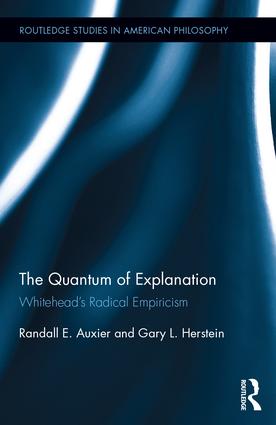
The Quantum of Explanation (book)

17 Friday Feb 2017

Posted by Gary Herstein in Logic, naturalism, Philosophy of Logic, Philosophy of Science, Whitehead

≈ 2 Comments

Tags

Philosophy of Logic, Process Philosophy, Process Theology, Science, Whitehead

Publication is almost upon us.

quantum-of-explanation

“The Quantum of Explanation advances a bold new theory of how explanation ought to be understood in philosophical and cosmological inquiries. Using a complete interpretation of Alfred North Whitehead’s philosophical and mathematical writings and an interpretive structure that is essentially new, Auxier and Herstein argue that Whitehead has never been properly understood, nor has the depth and breadth of his contribution to the human search for knowledge been assimilated by his successors. This important book effectively applies Whitehead’s philosophy to problems in the interpretation of science, empirical knowledge, and nature. It develops a new account of philosophical naturalism that will contribute to the current naturalism debate in both Analytic and Continental philosophy. Auxier and Herstein also draw attention to some of the most important differences between the process theology tradition and Whitehead’s thought, arguing in favor of a Whiteheadian naturalism that is more or less independent of theological concerns. This book offers a clear and comprehensive introduction to Whitehead’s philosophy and is an essential resource for students and scholars interested in American philosophy, the philosophy of mathematics and physics, and issues associated with naturalism, explanation and radical empiricism.”

This author’s profile can be found HERE.

More information on the book can be found HERE.

Let’s just say I’m a little excited.

Publication Announcement

02 Friday Sep 2016

Posted by Gary Herstein in Logic, Philosophy of Logic, Philosophy of Science, Process Theology, Whitehead

≈ 2 Comments

Tags

Logic, philosophy of science, Process Theology, Whitehead

Routledge has now offered a contract, so I can make official the anticipated publication of the book for which this blog is named:

Quantum

Continue reading →

Follow THE QUANTUM of EXPLANATION on WordPress.com

Enter your email address to follow this blog and receive notifications of new posts by email.

Blogs I Follow

  • The Shanarchist Cookbook
  • Cote du Golfe School of Fencing
  • Professor Watchlist redux
  • Free Range Philosophers
  • thenonsequitur.com
  • Blog Candy by Author Stacey Keith
Whitehead, Alfred North

Copyright Announcement

© Dr. Gary L. Herstein and garyherstein.com, 2014 -- 2024. Unauthorized use and/or duplication of this material without express and written permission from this site’s author and/or owner is strictly prohibited. Excerpts and links may be used, provided that full and clear credit is given to Dr. Gary L. Herstein and garyherstein.com with appropriate and specific direction to the original content. (In other words, share but acknowledge.)

Go back

Your message has been sent

Warning
Warning
Warning
Warning

“But in the real world it is more important that a proposition be interesting than that it be true. The importance of truth is, that it adds to interest.” – Alfred North Whitehead, Process and Reality

Archives

Spam Blocked

70,611 spam blocked by Akismet

Blog at WordPress.com.

The Shanarchist Cookbook

Cooking up food for thought & Shanarchy. I am a Philosopher, writer, meditation & mindfulness teacher, & artist.

Cote du Golfe School of Fencing

Fencing / Sword Classes & Lessons Naples, Bonita, Estero, Florida

Professor Watchlist redux

Free Range Philosophers

Loving Wisdom Beyond the Academy

thenonsequitur.com

Blog Candy by Author Stacey Keith

Science, logic, and ethics, from a Whiteheadian Pragmatist perspective (go figure)

  • Subscribe Subscribed
    • THE QUANTUM of EXPLANATION
    • Join 123 other subscribers
    • Already have a WordPress.com account? Log in now.
    • THE QUANTUM of EXPLANATION
    • Subscribe Subscribed
    • Sign up
    • Log in
    • Report this content
    • View site in Reader
    • Manage subscriptions
    • Collapse this bar
 

Loading Comments...